

June 3, 2026 | (14 mins 58 secs)
Copper is emerging as one of the most strategic materials of the modern economy, driven by accelerating demand from AI data centers, electrification, energy infrastructure and national security applications. Sprott CEO John Ciampaglia explains why copper's supply challenges, long mine development timelines and growing demand could support higher prices. He also explores how investors can gain exposure to the physical metal through Sprott Physical Copper Trust and what sets physical copper ownership apart from mining stocks and futures.
Video Transcript
James Connor: John, thank you very much for joining us today. Quite often, when you and I speak, we discuss critical materials, including copper. Copper has been very resilient this year. It's trading at or near all-time highs. You and your team have done a lot of work on both the supply and demand fundamentals for copper. What is driving the copper price this year?
John Ciampaglia: I think what's really driving it is growing recognition that copper is a critical material for several very important industries that are related to national security and energy security. Those are everything from AI data centers, which are very copper-intensive, to energy infrastructure systems, electric vehicles and other technologies. If you think about anything that has to move an electron through a cable or a wire, it involves copper, so it's very important.
We've been mining copper for over 5,000 years, and all of the easy stuff has been found. Now, we're being forced to find larger copper deposits in geopolitically risky regions like the DRC (Democratic Republic of Congo) or in challenging environments, such as the Andes, where these deposits are at very high elevations, sometimes 15,000 feet or more above sea level. There are challenges with water at those elevations as well. The copper in the ground will require more effort and higher costs to extract.
I think that's one of the key signals why copper has been very resilient. It has also become much less closely linked to other traditional industrial metals. If you think about copper and iron ore, historically, they've always been very well correlated. You notice that over the last couple of years, they have decoupled: the price of iron ore has been quite soft, whereas copper is almost at an all-time high. It's really behaving differently because of its importance in electrification, energy systems and national defense.
James Connor: You touched on Chile, the world's largest copper producer. They produce around 24% of global production. That number peaked in 2018, and it's been declining ever since. The other very interesting point you made is that they now have to go higher to find these copper deposits. Can you imagine working at 15,000 feet?
John Ciampaglia: I have once in my life been at over 15,000 feet, and I can tell you it really taxes your body because the amount of oxygen in the atmosphere is substantially lower. You need to be superhumanly conditioned to operate at those high elevations. Local people, obviously, are well-conditioned to do that. But these are some of the challenges.
If you take a step back and think about the last 100 years or so, what you see is that about every 25 years, the demand for copper doubles. That's because of growing wealth effects as we become more industrialized, as more people consume things like washers and dryers, dishwashers and air conditioners. These are all very copper-intensive.
People get very excited about electric vehicles, the copper intensity of those, and AI data centers. But it's a lot of just very basic things that we take for granted every day, where hundreds of millions of people in the world want to enjoy the privileges of having a washer, dryer or air conditioner. Those are all very copper-intensive.
This long history of doubling demand every 25 years or so is well underway. The other thing about copper, people call it Dr. Copper, and they use that expression to describe copper as a barometer for the health of the global economy. If the global economy weren't doing well for whatever reason, such as a recession, the price of copper would fall. What you're starting to see is copper beating to its own drum and decoupling from softer global economic growth. That's because copper is becoming less important as a traditional industrial metal and more important for these new technologies and new sectors of the economy. That old relationship is starting to fade away.
James Connor: Robert Freeland quite often throws out a very interesting stat. He says, "Since the beginning of time, 700 million tons of copper have been mined, and we're going to need a similar amount of copper in the next 18 to 22 years." That really speaks to this demand or growth for copper.
John Ciampaglia: Absolutely. I think the second part of that story is that the lead times for developing large copper mines are long. Not just the lead times, we're talking about 15 or 20 years to bring these big projects, but also the capital expenditure to build these projects. It's not a $1 billion or $2 billion endeavor. Some of these projects are worth $15 to $20 billion to build.
You can imagine that, as stewards of shareholder capital, management teams at these copper companies are very disciplined and careful not to bring on capacity unless they believe demand will be there and pricing will be durable enough to justify these big investments.
That math is starting to happen. People talk about copper being at an all-time high. But think about it in inflation-adjusted terms. The copper price is higher than in the last cycle, but in inflation-adjusted terms, we're still at much lower levels. We think there's more room to incentivize the new production we'll ultimately need to bring on to rebalance the market.
James Connor: We discussed all the reasons why copper has been moving higher. Now, Sprott has created several products for investors, allowing them to invest in various physical metals, including gold, silver, uranium and copper. Can you speak to this product, Sprott Physical Copper Trust?
John Ciampaglia: We're proud of Sprott Physical Copper Trust because it's the first physical copper vehicle to be listed on an exchange worldwide. At the beginning of May, we were able to list it on the New York Stock Exchange. This is the first ever listed in the U.S. The vehicle is designed to allow investors to play the physical commodity and invest in it through our listed trust.
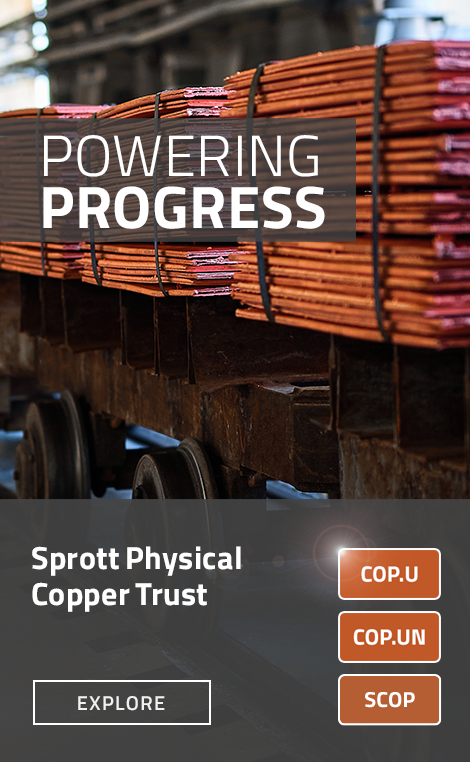
What the vehicle does is it raises capital when it trades above its net asset value. With the proceeds, we buy copper cathodes, which are sheets of copper about 1 meter by 1 meter. We store them in London Metal Exchange (LME) -approved warehouses. Right now, the trust owns about 14,600 metric tons of copper, which is worth just a little over $200 million U.S. dollars. We want to provide investors with direct exposure to the commodity.
Why would an investor choose to invest in the commodity versus the miners? It's not an either-or; we often find it's both. Most of the investors we talk to have some exposure to mining stocks because they're well-positioned right now, making strong profits given current cost structures. The price of copper is quite robust.
But we find that holding them together is a nice complement. It has different risk characteristics. If you think about what you own, sheets of copper in a warehouse, it's very different than a mine that, as we just talked about, could have a flood, it could have a slide, it could have a cave-in, or some increased mineral extraction tax or royalty regime that comes in.
There are different risks between owning physical assets and investing in mining equities, which have greater operating leverage but also greater production and geopolitical risks. It's a unique vehicle. As I said, the vehicle is about $200 million. It's been growing really nicely this year. Our goal is to keep growing it so more institutional investors can participate.
James Connor: Many of our viewers are familiar with the Sprott Physical Uranium Trust. It sounds like a very similar product in the way it operates.
John Ciampaglia: There's one key difference between the two: the Copper Trust, as of the beginning of May of this year, has implemented a monthly redemption option that can be in cash or physical form. Now, to take title to physical copper, you need to have a minimum number of units equivalent to at least 100 metric tons. We're talking about $1.4 million, so it's not eligible for all investors, and you need to take title at the warehouse.
More importantly, this redemption mechanism will incentivize different market participants to step in and buy the trust if it trades too far from its net asset value. This is a very powerful incentive. What we've noticed is that, over the last few months, trust in anticipation of this structural change in the vehicle has indeed traded much closer to its net asset value, allowing us to raise a good chunk of capital in the vehicle this year. That's another important structural enhancement we implemented alongside the New York Stock Exchange listing at the beginning of May.
James Connor: Since you started trading on the New York Stock Exchange, how has it been received?
John Ciampaglia: We're seeing trading volume slowly migrate to New York. There is still healthy trading in Toronto. You can buy the trust on the Toronto Stock Exchange in Canadian dollars and U.S. dollars, if you like. But the volume in U.S. dollars is clearly migrating to the New York Stock Exchange, a pattern we also see with most of our other trusts.
James Connor: John, I read about trading futures on the COMEX or the LME quite often. What are the advantages of owning the Sprott Physical Copper Trust as opposed to trading copper futures?
John Ciampaglia: The copper market is big in total size, and the futures market is a big part of that for hedging and speculation purposes. I think for many investors, investing in futures is just way beyond their level of comfort. Many institutional investors, even though they're sophisticated, are not allowed to invest in derivatives or futures markets. There is one negative aspect relative to owning physical, and that is the negative roll yield. Every time you need to roll a contract as it comes closer to maturity, there's a negative roll because the shape of the curve is upward sloping.
There's this negative roll yield that erodes your returns. If you own physical copper, there is no negative roll yield. There's a cost to store the material, so there's a bit of a trade-off. But right now, that roll yield is pretty material. Again, not all investors can dabble or are willing to invest in futures, and we avoid the negative roll yield associated with futures markets in contango, which copper is in right now.
James Connor: John, since this product was created in 2024, the shareholder base has changed significantly. Can you speak to that?
John Ciampaglia: We had an IPO back in June of 2024 that was about $100 million. It was fairly concentrated in a small number of institutional investors. Since that time, we've seen a broadening of investor interest. We've seen new institutions come in. Some of the existing shares have turned over, which is important because I think one of the early knocks on the vehicle was that it didn't seem to trade much. That's because institutions bought the shares at an IPO. They weren't trying to day-trade this thing or market-time copper; they had a longer-term positive view on copper.
Now that some shares are starting to change hands and we're issuing new ones, we're seeing a larger pool of investors across more institutions, advisors, and individual investors. That's very healthy to have more float, more liquidity. Ultimately, we believe the New York Stock Exchange listing will make the shares more accessible to a much larger capital pool, as previously we were only listed on the OTC market in the U.S.
James Connor: John, this has been a great discussion. I want to thank you very much for taking the time with us today and for sharing your thoughts on what's happening in the copper sector. If somebody would like to learn more about Sprott and its various products, where can they go?
John Ciampaglia: Please visit us at sprott.com. There, you can learn about the Sprott Physical Copper Trust. You can also learn about our various copper mining ETFs, which we find are often a nice complement to physical copper. Also, check out our Education Center. We have a lot of good content we put out, including market analysis and coverage, to talk about all of these metals. Investor education is really important to us.
James Connor: John, once again, thank you.
John Ciampaglia: Thanks for having me.
Important Disclosure
*Sprott Physical Copper Trust is the world's largest physical copper fund based on Morningstar’s universe of listed commodity funds. Data as of 9/30/2026.
Sprott Physical Copper Trust (the “Trust”) is a closed-end fund established under the laws of the Province of Ontario in Canada. The Trust is generally exposed to the multiple risks that have been identified and described in the prospectus. Please refer to the prospectus for a description of these risks. Relative to other sectors, precious metals and natural resources investments have higher headline risk and are more sensitive to changes in economic data, political or regulatory events, and underlying commodity price fluctuations. Risks related to extraction, storage, and liquidity should also be considered.
All data is in U.S. dollars unless otherwise noted.
Past performance is not an indication of future results. The information provided is general in nature and is provided with the understanding that it may not be relied upon as, nor considered to be tax, legal, accounting or professional advice. Readers should consult with their own accountants and/or lawyers for advice on their specific circumstances before taking any action. Sprott Asset Management LP is the investment manager to the Trust. Important information about the Trust, including the investment objectives and strategies, applicable management fees, and expenses, is contained in the prospectus. Please read the prospectus carefully before investing. The indicated rates of return are the historical annual compounded total returns including changes in unit value and reinvestment of all distributions and do not take into account sales, redemption, distribution or operational charges or income taxes payable by any unitholder that would have reduced returns. You will usually pay brokerage fees to your dealer if you purchase or sell units of the Trust on the Toronto Stock Exchange (“TSX”) or the NYSE Acra. If the units are purchased or sold on the TSX or the NYSE Acra, investors may pay more than the current net asset value when buying units of the Trust and may receive less than the current net asset value when selling them. Investment funds are not guaranteed, their values change frequently and past performance may not be repeated. The information contained herein does not constitute an offer or solicitation to anyone in the United States or in any other jurisdiction in which such an offer or solicitation is not authorized.