

Key Takeaways
- Strategic Demand Is Building: Defense, electrification, AI and reshoring are increasing demand for secure rare earth supply.
- China Controls the Bottleneck: China’s dominance in refining and magnet production makes alternative supply chains difficult, and time-consuming, to build.
- Ex-China Supply Commands a Premium: Export controls have created wide regional price gaps, highlighting the value of material available outside China.
- Policy Is Changing Project Economics: Price floors, offtake agreements and government support may improve the viability of ex-China projects.
- REXC’s Reset Looks Liquidity-Driven: Continued inflows into Sprott Rare earths Ex-China ETF (REXC) and firm rare earth prices suggest the selloff reflects deleveraging more than a weaker long-term thesis.
Rare Earths Have Become Strategic Infrastructure
The long-term rare earth investment case extends beyond a directional view on commodity prices. It reflects deglobalization, geopolitical fragmentation, rearmament, energy security, electrification, AI infrastructure, reshoring and resource nationalism. The global system is shifting from maximum efficiency toward resilience, redundancy and security of supply. Materials critical to defense, energy and advanced manufacturing are increasingly being valued for assured access rather than marginal production cost.
Permanent magnets are essential to high-performance motors, wind turbines, robotics and advanced weapons systems; rare earths also support semiconductors, aerospace, communications and advanced electronics. Rising defense, energy transition, and AI investments create several sources of structural demand.
The central question: Can commercially viable, integrated supply chains be financed and built outside China?
Concentrated Supply Meets Inelastic Demand
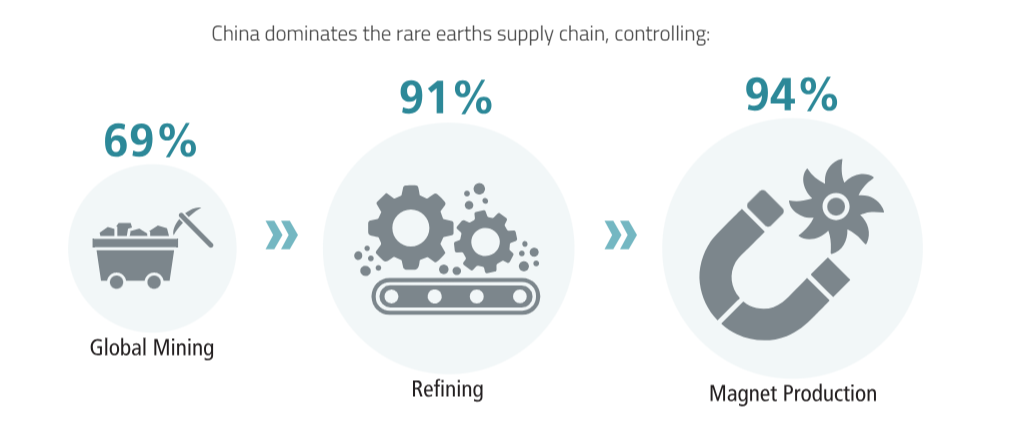
China accounts for approximately 69% of rare earth mining, 91% of refining and 94% of permanent magnet production. This dominance reflects decades of coordinated industrial policy and investment across the entire value chain. Recent export controls and licensing restrictions demonstrate how that concentration can be used as an instrument of statecraft.
Higher prices cannot quickly resolve this concentration. Secure supply requires separation, refining, metallurgy and magnet manufacturing, not simply new mines. Reconstructing a mine-to-magnet ecosystem outside China demands capital, specialized expertise, customer qualification and long development timelines.
For heavy rare earths such as dysprosium and terbium, the constraint is not geology but the availability of processed, deliverable material that is legally and commercially accessible to non-Chinese buyers. Buyers therefore compete for a limited pool of available production. Jurisdiction and availability matter more than the quoted domestic commodity price, while higher prices generate new supply only with long lags.
Export Controls Turn China's Dominance into Leverage
China's dominance of the rare earth supply chain is no longer simply a concentration risk. The introduction of export controls has demonstrated how that dominance can translate into strategic leverage. U.S.-bound shipments of rare earth compounds and metals covered by China's April 2025 export controls have averaged just 19.3 metric tonnes per month from November 2025 through September 2026, compared with 76.8 metric tonnes per month from June 2024 through March 2025 (see Figure 1). The persistence of this shortfall highlights the strategic vulnerability created by concentrated Chinese processing capacity and strengthens the economic and national-security case for developing independent ex-China rare earth supply chains.
Figure 1. Chinese Shipments of Controlled Rare Earths to the U.S. Remain Depressed
Shipments to the U.S. of Rare Earth Compounds and Metals Subject to China's April 2025 Export Controls
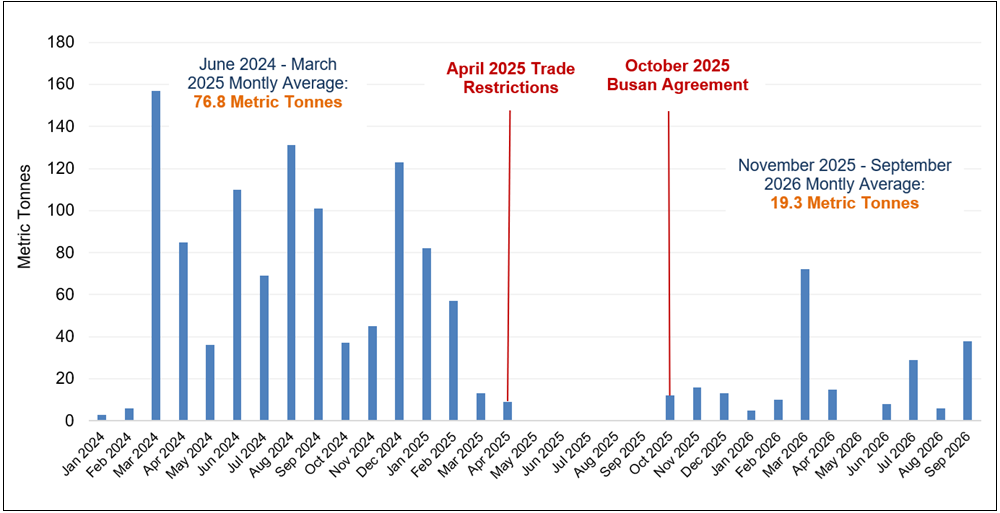
Note: While the Busan Agreement in October 2025 averted a total supply cutoff by suspending Beijing's strictest proposed export controls, U.S. imports of Chinese rare earths still plummeted by 75% in the following year. Source: Silverado Policy Accelerator1; Sprott Asset Management. Data through September 2026.
The national security implication is significant. Rare earths are used in aircraft, missiles, drones, naval systems, radar and other advanced defense applications, where substitution is difficult and supply security is more important than marginal input costs. The U.S. therefore faces an unusual vulnerability: A strategic competitor controls much of the processing and manufacturing capacity for materials required by critical U.S. defense and industrial systems. U.S. policy is consequently moving beyond simply encouraging additional mining. Government funding, guaranteed offtake and price support, including a $110/kg NdPr (neodymium-praseodymium) price floor for a major domestic producer, increasingly reflect a willingness to pay a premium to establish supply chains outside China's control.
Supply insecurity is catalyzing an ex-China rare earth ecosystem.
For investors, the more important second order effect may be that every episode of Chinese supply restrictions strengthens the economic case for the very ex-China capacity intended to reduce China's future market power. Reduced Chinese shipments raise the value of secure inventories, processing capacity, long-term offtake agreements and non-Chinese mine-to-magnet production. They also increase the political willingness to subsidize projects that might not have been economically viable under the old globally integrated model. The tighter China exercises its supply-chain leverage, the stronger the incentive for the U.S. and the West to fund competing supply chains. Over time, this feedback loop could accelerate the development of a parallel ex-China rare earth ecosystem and shift valuations toward strategically important assets based not simply on commodity prices, but on jurisdiction, availability and security of supply.
A Two-Tier Rare Earth Market Is Emerging
The widening gap between Chinese and Western prices for yttrium, dysprosium and terbium provides clear evidence that rare earth markets are becoming increasingly regionalized and fragmented. Western prices have risen sharply, while domestic Chinese prices have remained comparatively subdued, reflecting the increasing value of material physically available outside China. Inventories of dysprosium and terbium in the West have become extremely thin, forcing buyers, including emerging North American magnet producers, to pay substantial premiums for small volumes.
This physical scarcity is particularly important for defense supply chains. China accounts for approximately 97% of the global supply of refined dysprosium and terbium, and 94% of the global supply of samarium oxide, making separated heavy rare earths a potential bottleneck for defense applications. Ex-China premiums for dysprosium and terbium could therefore remain elevated or widen further as defense demand, geopolitical tensions and tighter supply-chain controls increase competition for limited Western-accessible material. Although defense accounts for a relatively small share of total rare earth demand, its strategic importance and low price sensitivity can exert an outsized influence on marginal pricing.
Yttrium Reveals the Cost of Supply Insecurity
China's export controls are creating distinct domestic and ex-China markets for strategically important rare earths. Yttrium oxide illustrates the extreme case: comparable high-purity material trades near $9/kg inside China versus roughly $1650/kg in North America, an approximately 185x differential (see Figure 2). The divergence reflects less a change in the intrinsic value of yttrium than the scarcity and strategic value of material physically available outside China.
This also strengthens the argument for ex-China development. At an enormous 185x spread, the discussion shifts from whether a Western mine or processor can compete with China's cost structure to what a secure ex-China supply is actually worth. The current premium is unlikely to persist at this extreme scale, but it need not do so for ex-China supply to become materially more economical. That distinction is central to the REXC thesis. Historically, low Chinese domestic prices could render Western projects uneconomic. Export restrictions create a security-of-supply premium that improves the economics of ex-China mining, separation and refining, encourages long-term offtake, and increases governments' willingness to provide price floors, financing or other support.
Figure 2. Yttrium’s Ex-China Security-of-Supply Premium
Yttrium Oxide Prices: China vs. Ex-China (US$/kg)
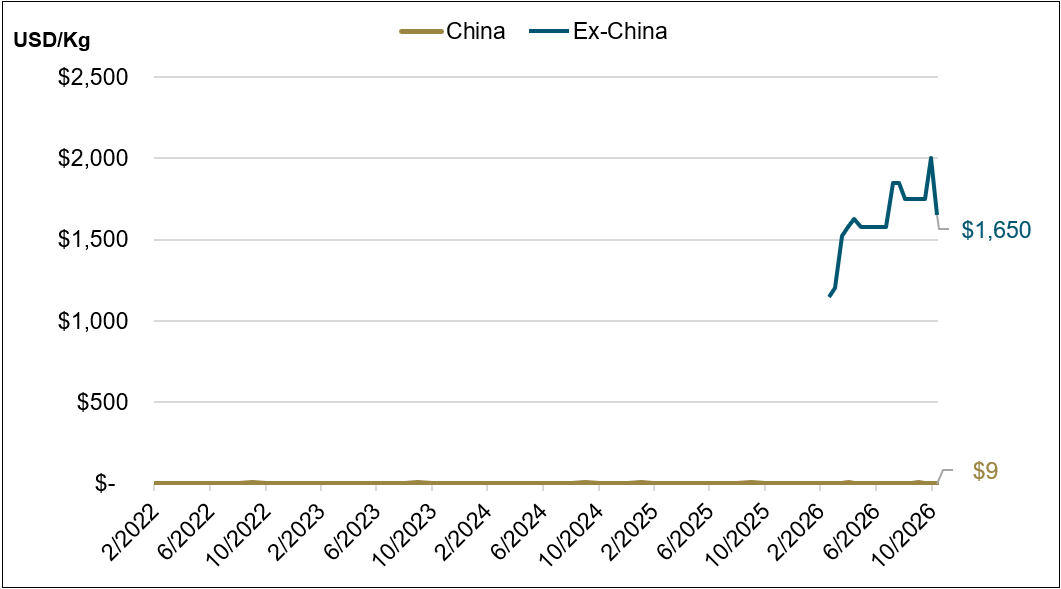
Source: Bloomberg and Benchmark Mineral Intelligence data as of 11/17/2026. Ex-China is measured by Yttrium Oxide, 99.999%; CIF North America price. The China price is measured by the YTCNLVFC AMTL Index.
Yttrium illustrates how China's export controls can transform a relatively small specialty-metal market into a national-security vulnerability. For example, yttrium is critical in heat-resistant coatings for advanced jet engines, including the F-35, protecting components from melting under the extreme temperatures generated by the engine. Yttrium is also used in lasers and advanced optical systems. The U.S. remains 100% net-import reliant and lacks fully commercial domestic yttrium separation and refining capacity, while nearly all imported material ultimately originates from concentrates processed in China. This combination of concentrated processing, limited substitution and strategically important end uses helps explain the extraordinary premium now commanded by yttrium physically available outside China. [pubs.usgs.gov], [osti.gov]
China's export controls have fractured the dysprosium market (see Figure 3): ex-China dysprosium oxide now trades near $4875/kg, almost 22x the Chinese domestic price, reflecting growing scarcity and a security-of-supply premium for a critical input to high-performance permanent magnets.
Figure 3. Dysprosium’s Ex-China Security-of-Supply Premium
Dysprosium Oxide Prices: China vs. Ex-China (US$/kg)
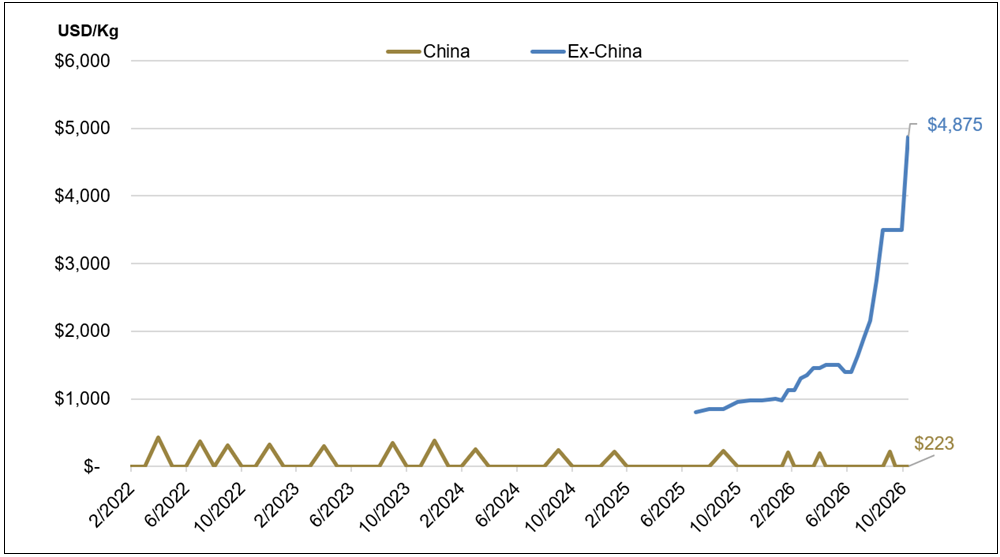
Source: Bloomberg and Benchmark Mineral Intelligence data as of 11/17/2026. Ex-China is measured by Dysprosium Oxide; 99.0-99.5%; CIF Europe. The China price is measured by the DMCNCFZS AMTL Index.
China's export controls have also fractured the terbium market (see Figure 4): ex-China terbium oxide now trades near $10,500/kg versus roughly $944/kg in China, a more than 11x premium for material available outside China, highlighting the growing scarcity and security-of-supply premium for a critical input used in high-performance permanent magnets.
Figure 4. Terbium’s Ex-China Security-of-Supply Premium
Terbium Oxide Prices: China vs. Ex-China (US$/kg)
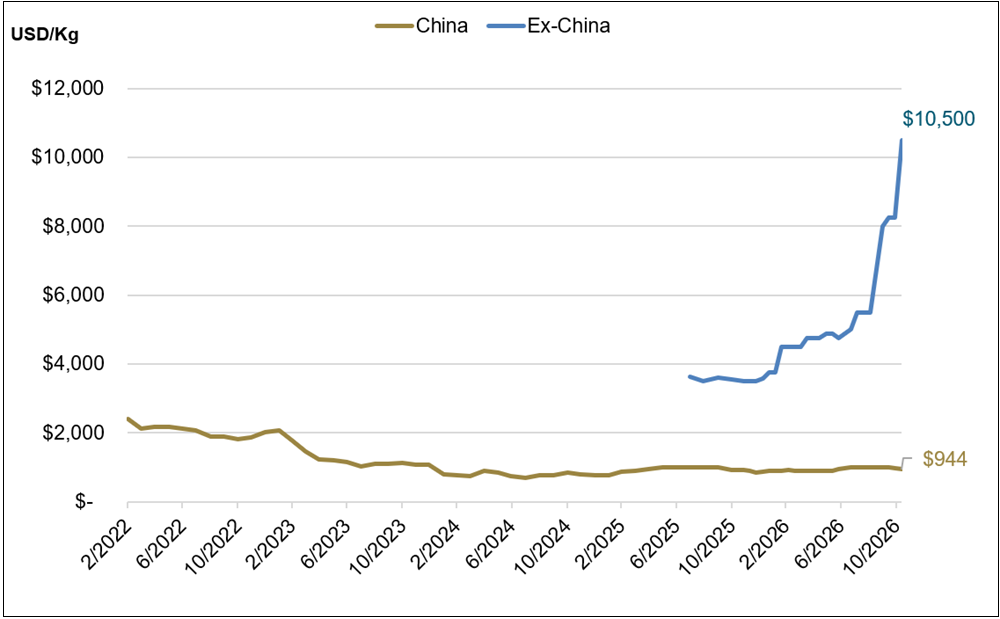
Source: Bloomberg and Benchmark Mineral Intelligence data as of 11/17/2026. Ex-China is measured by Terbium Oxide; 99.0-99.9%; CIF Europe. The China price is measured by the TBCNQALC AMTL Index.
The growing divergence indicates that Western consumers are paying a significant security-of-supply premium. Export restrictions have effectively segmented the market, leaving buyers outside China competing for a much smaller pool of available material, even though domestic Chinese prices remain lower. Prices resemble a scarcity premium more than a conventional cyclical commodity rally. Price discovery is shifting away from production costs and toward physical availability, legal accessibility and supply-chain control. The market is moving from being price-constrained to availability-constrained.
Rare earths are becoming availability-constrained, not price-constrained.
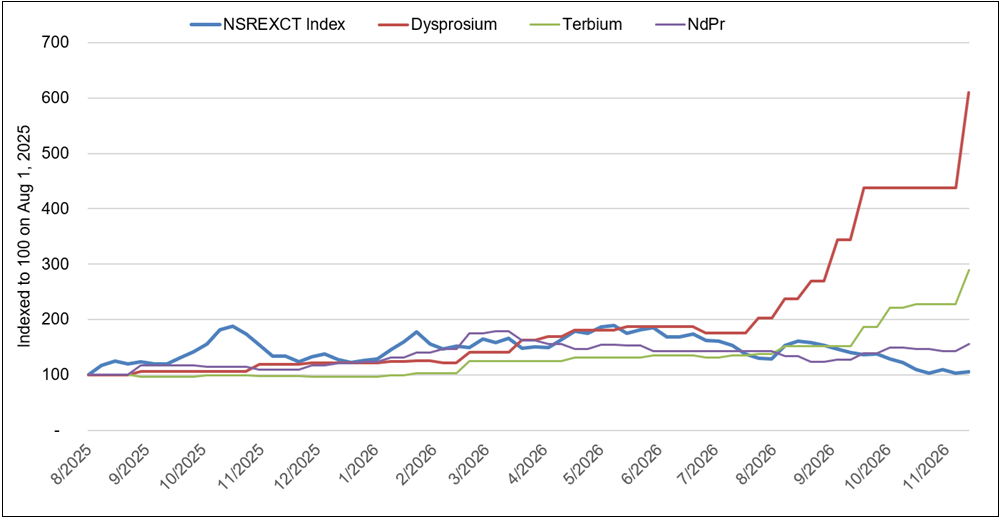
Heavy rare earth prices have remained firm even as REXC has weakened alongside broader high-beta and small-cap equities amid tightening market liquidity (see Figure 5). The divergence suggests the equity drawdown has reflected financial conditions more than deterioration in the underlying commodity signal.
Figure 5. REXC Has Diverged from Ex-China Rare Earth Prices
REXC vs. Rare Earth Ex-China Prices, Indexed to 100 on Aug 1, 2025
Source: Bloomberg and Benchmark Mineral Intelligence data as of 11/17/2026.
Industrial Policy Is Changing Project Economics
Western governments are moving beyond critical-mineral lists and policy statements. Support increasingly includes direct equity investment, concessional financing, long-term offtake agreements, strategic stockpiles and explicit price support. Recently, major ex-China supply chain participants have secured price floors of approximately $110 per kilogram for neodymium-praseodymium. Such arrangements can support non-Chinese production economics even when Chinese domestic prices remain materially lower.
This creates the potential for two distinct markets:
- A China-centered market priced around domestic Chinese production and industrial policy.
- An ex-China market in which governments and customers pay a premium for reliable, traceable and geopolitically secure supply.
The resulting opportunity is broader than mining. It potentially encompasses separation, refining, metallurgy, recycling, magnet manufacturing and inventory ownership. Companies that control scarce resources, together with downstream capabilities, may capture more value than businesses offering only commodity exposure.
Strategic stockpiling could reinforce this effect. When consumers become concerned about availability, inventory changes from a working-capital cost into a strategic asset. Long-term contracts may also displace spot transactions as defense, automotive, and industrial customers prioritize continuity of supply over obtaining the lowest short-term price.
REXC's Decline Reflects Liquidity, Not Fundamentals
Rare earth equities have corrected sharply despite the constructive strategic backdrop. Liquidity peaked in the summer and deteriorated from late August onward; rare earth equities, uranium miners and other high-beta resource equities then weakened together. In Figure 6, the liquidity proxy (L1) turns first; resource equities (R1 & R2) and small caps (R3) follow, and deleveraging amplifies the decline into October and November.
Figure 6: Resource Equities Declined as Market Liquidity Tightened
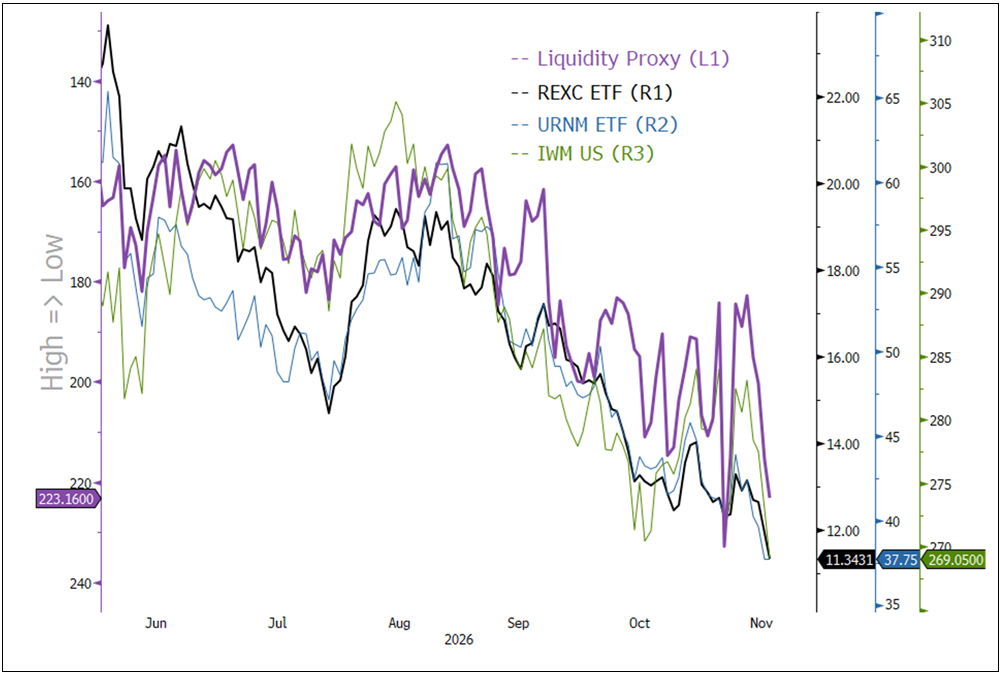
Source: Bloomberg. Data as of 11/17/2026.
Multi-strategy funds and other leveraged investors operate under strict risk limits. As losses and volatility rise, managers may be forced to reduce gross exposure regardless of their fundamental view. That procyclical process is especially damaging to smaller resource equities, where high volatility and limited market depth can produce sharp declines without comparable deterioration in long-term fundamentals.
REXC has therefore behaved less like a direct proxy for rare earth fundamentals and more like a high-beta illiquid asset. Tighter conditions raise discount rates, compress multiples and increase financing risk. Still, they do not create ex-China refining capacity, weaken defense demand or reduce the strategic value of supply-chain diversification.
Fund Flows Suggest Investors Remail Committed
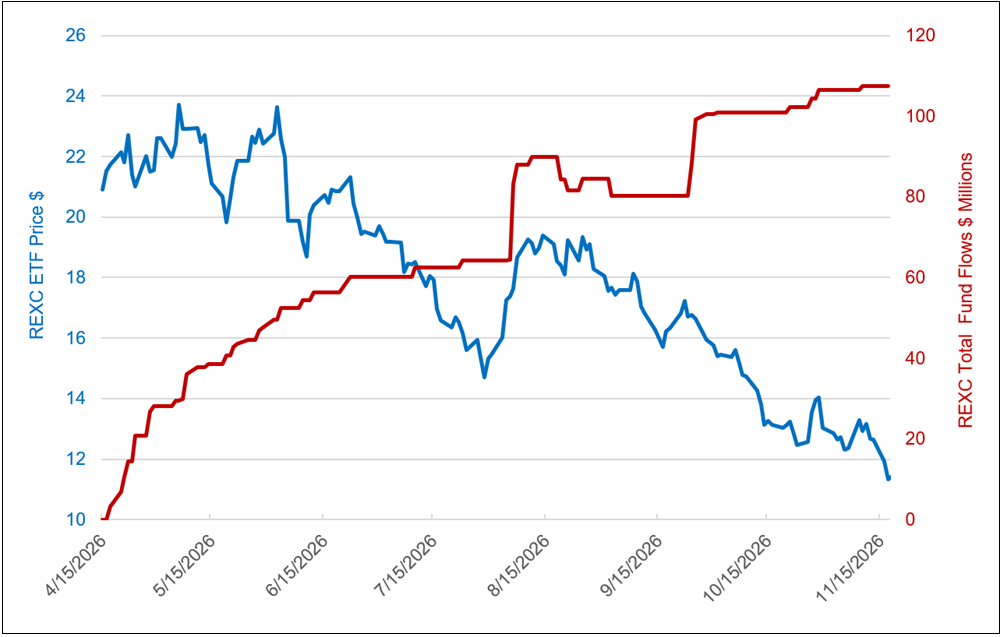
Fund flows provide an important cross-check. REXC's cumulative inflows (see Figure 7) have continued to rise despite falling prices, suggesting investors are not broadly abandoning the thesis. The pattern is more consistent with underlying demand being overwhelmed by liquidity-sensitive selling. The key distinction is forced liquidation versus fundamental impairment.
Figure 7. REXC Inflows Persisted Through the Selloff (2026)
Source: Bloomberg. Data as of 11/17/2026.
What May Reconnect REXC with Fundamentals?
The divergence between REXC and rare earth fundamentals may persist until market liquidity improves and ex-China price discovery strengthens.
Improving Market Liquidity: Lower Treasury and equity volatility would reduce deleveraging pressure, improve risk appetite and lower the cost of capital for smaller rare earth companies. This would allow sector fundamentals to reassert themselves as a more important driver of equity prices.
Ex-China Price Discovery: Persistent Western premiums for dysprosium, terbium and other strategic rare earths would validate the scarcity value of secure non-Chinese supply. The key signal is not simply higher commodity prices, but sustained regional price differentials that increasingly support long-term contracts, price floors and investment in ex-China supply chains.
Commercial Validation: Government support, long-term offtakes, project financing and successful commissioning would reinforce this price signal and increasingly differentiate commercially viable, integrated producers from more speculative projects.
Liquidity Reset, Not a Broken Thesis
REXC's correction appears primarily liquidity-driven rather than evidence of a broken strategic thesis. Deleveraging may remain a near-term headwind, but rearmament, electrification, AI infrastructure, reshoring, and geopolitical fragmentation continue to strengthen long-term structural demand for secure supply.
The more China restricts supply, the stronger the incentive to build supply chains outside China.
China's export controls are accelerating the rationale for ex-China supply chains. U.S.-bound shipments of controlled materials remain far below pre-control levels, while wide China-versus-ex-China price differentials for yttrium, dysprosium and terbium reveal the premium attached to physical availability. China's dominance in processing and magnets cannot be replicated quickly, increasing incentives to support alternative mining, separation, refining, and magnet capacity.
The second-order effect is important: the more China uses its supply-chain leverage, the stronger the incentive to finance capacity that ultimately reduces that leverage. Scarcity premiums, price support, long-term offtakes and strategic procurement can improve project economics and reduce development risk. REXC therefore offers exposure not merely to higher rare earth prices, but to a multi-year restructuring of the global supply chain. As liquidity pressures recede, strategic scarcity and policy-backed investment should become more influential drivers of rare earth equity valuations.
Access Rare Earth Companies with Sprott
For investors looking to participate in this trend, Sprott offers exposure to the critical materials ecosystem, including three ETFs that invest in rare earth companies.
Sprott Rare Earths Ex-China ETF (Nasdaq: REXC) is the only* ETF providing focused pure-play† exposure to rare earth companies. The ETF invests exclusively in companies outside of China that may have significant growth potential as supply chain security becomes a national priority.
Sprott Active Metals & Miners ETF (Nasdaq: METL) is an actively managed ETF that aims to provide long-term capital appreciation by investing in companies across the metals and mining industry lifecycle, including miners, recyclers, and royalty and streaming companies associated with commodities that are in high global demand.
Sprott Critical Materials ETF (Nasdaq: SETM) provides pure-play† access to a range of critical materials, including rare earths, essential to meeting rising global energy demand.
* Based on Morningstar's universe of Natural Resources Sector Equity ETFs as of 9/30/2026.
† The term "pure-play" relates directly to the exposure that the Fund has to the total universe of investable, publicly listed securities in the investment strategy.
What Are Rare Earths?
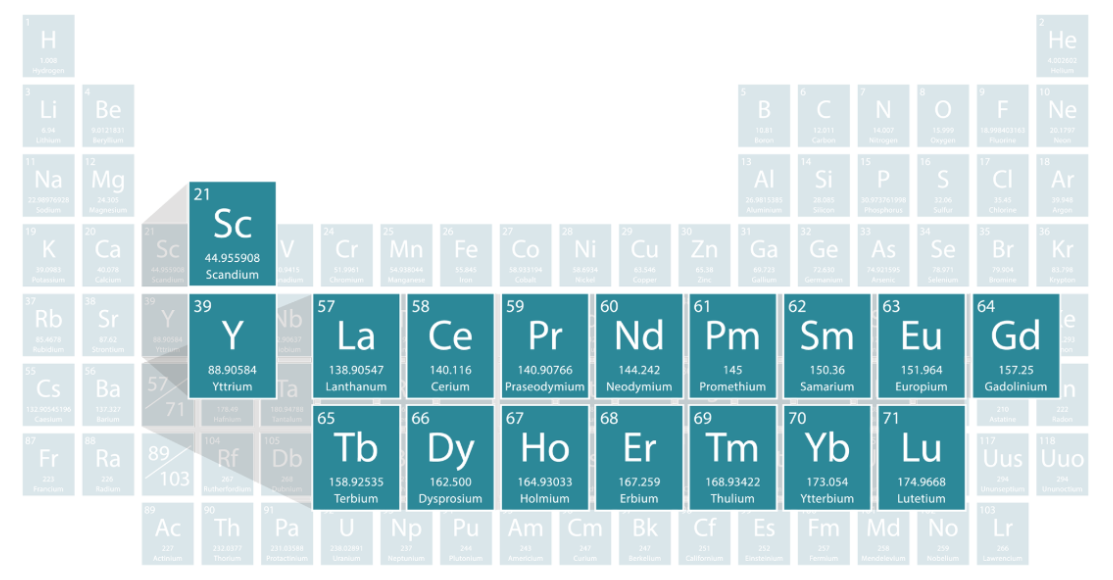
Rare earth elements (REEs) are a subset of critical materials, consisting of 17 chemically similar elements essential to high-performance technologies. While critical materials include resources vital to economic stability and national security, rare earths play a uniquely important role within this group.
The 17 rare earth elements in order of atomic number are scandium (Sc, 21), yttrium (Y, 39), lanthanum (La, 57), cerium (Ce, 58), praseodymium (Pr, 59), neodymium (Nd, 60), promethium (Pm, 61), samarium (Sm, 62), europium (Eu, 63), gadolinium (Gd, 64), terbium (Tb, 65), dysprosium (Dy, 66), holmium (Ho, 67), erbium (Er, 68), thulium (Tm, 69), ytterbium (Yb, 70), and lutetium (Lu, 71).
Additional Rare Earth Resources
Infographic: Rare Earths Essential to Defense
Special Report: Rare Earths Deliver the Hidden Power Behind Modern Defense
Video: Why the World Is Racing to Secure Rare Earths
Footnotes
| 1 | Silverado Policy Accelerator, Rare Earth Trade Report (October 2026); Global Trade Tracker. The data represent the gross weight of Chinese exports to the United States under tariff lines that are fully covered by China's April 2025 export controls, including controlled products containing yttrium, dysprosium, terbium, lutetium, scandium, samarium, and gadolinium. Monthly values aggregate shipment weight and are not converted to rare earth-oxide or elemental-content equivalent. The series excludes partially covered products and downstream permanent magnets. Historically, yttrium has represented the largest U.S.-bound volume among the fully controlled tariff lines. Period averages are calculated from monthly observations. |

Important Disclosures
An investor should consider the investment objectives, risks, charges and expenses of each fund carefully before investing. To obtain a fund’s Prospectus, which contains this and other information, contact your financial professional, call 1.888.622.1813 or visit SprottETFs.com. Read the Prospectus carefully before investing.
Exchange Traded Funds (ETFs) are considered to have continuous liquidity because they allow for an individual to trade throughout the day, which may indicate higher transaction costs and result in higher taxes when fund shares are held in a taxable account.
Diversification does not protect against loss. The funds are non-diversified and can invest a greater portion of assets in securities of individual issuers, particularly those in the natural resources and/or precious metals industry, which may experience greater price volatility. Relative to other sectors, natural resources and precious metals investments have higher headline risk and are more sensitive to changes in economic data, political or regulatory events, and underlying commodity price fluctuations. Risks related to extraction, storage and liquidity should also be considered.
Gold and precious metals are referred to with terms of art like "store of value," "safe haven" and "safe asset." These terms should not be construed to guarantee any form of investment safety. While “safe” assets like gold, Treasuries, money market funds and cash generally do not carry a high risk of loss relative to other asset classes, any asset may lose value, which may involve the complete loss of invested principal.
Shares are not individually redeemable. Investors buy and sell shares of the funds on a secondary market. Only “authorized participants” may trade directly with the fund, typically in blocks of 10,000 shares.
Sprott Asset Management USA, Inc. is the Investment Adviser to the Sprott ETFs. ALPS Distributors, Inc. is the Distributor for the Sprott ETFs and is a registered broker-dealer and FINRA Member. ALPS Distributors, Inc. is not affiliated with Sprott Asset Management USA, Inc.