

Key Takeaways
- Strong August Performance: Uranium prices advanced in August, while uranium mining equities and junior miners posted even stronger gains.
- Record Term Prices: Uranium's long-term price reached an all-time high, improving the economics and visibility needed for new mine supply.
- The Contracting Cycle Is Near: Utilities face a sharp decline in uranium coverage after 2030, setting up a potentially active period for long-term contracting.
- Nuclear Ambition Needs Fuel: Plans to expand nuclear power are shifting from policy support to construction and procurement, making future uranium supply essential.
- U.S. Demand Is Becoming Strategic: Proposed government purchases of domestic uranium could equal roughly all current U.S. mine production, adding competition for the limited supply.
Performance as of August 31, 2026
| Metric | 1 MO* | 3 MO* | YTD* | 1 YR | 3 YR | 5 YR |
|
U3O8 Uranium Spot Price1 |
3.63% | 5.41% | 9.81% | 17.68% | 13.88% | 21.09% |
| Uranium Mining Equities (VettaFi Global Uranium Mining Index)2 |
17.29% | -6.82% | 4.60% | 15.35% | 18.92% | 17.57% |
| Uranium Junior Mining Equities (Nasdaq Sprott Junior Uranium Miners Index TR)3 |
19.20% | -7.88% | 3.31% | 17.08% | 17.56% | 12.68% |
|
Broad Commodities (BCOM Index)4 |
7.05% | 4.63% | 28.88% | 37.53% | 10.05% | 8.05% |
|
U.S. Equities (S&P 500 TR Index)5 |
2.72% | 1.68% | 13.14% | 20.38% | 21.02% | 12.78% |
*Performance for periods under one year is not annualized.
Source: Bloomberg as of 8/31/2026. You cannot invest directly in an index. Past performance is no guarantee of future results.
Performance Overview: Record Term Prices Lift Uranium Miners
The uranium market strengthened through August, with rising spot and term prices supporting sharp gains in uranium mining equities. Physical-market momentum continued into September following a constructive World Nuclear Symposium, with uranium entering its seasonally active contracting period.
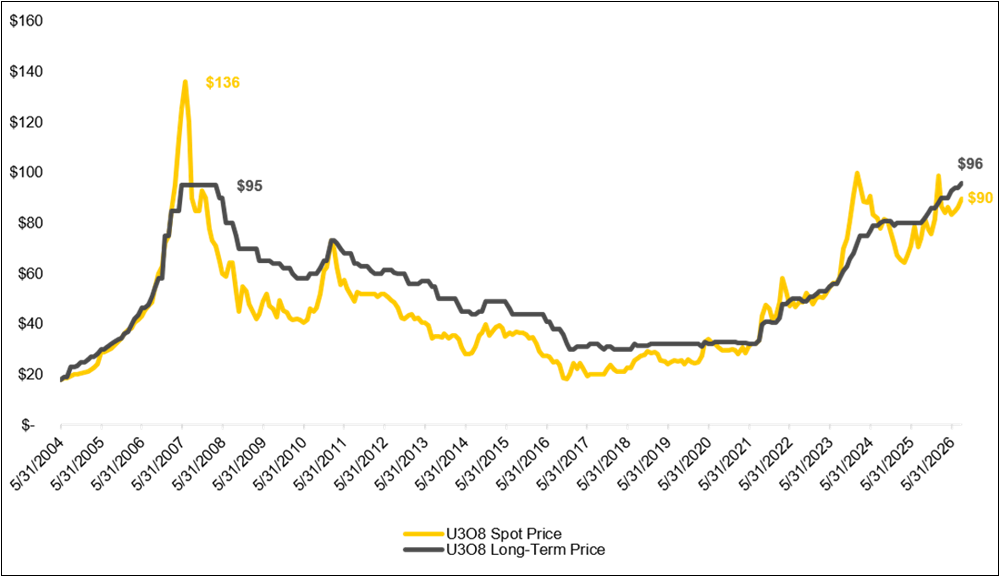
The long-term uranium price increased to an all-time high of $96 per pound, surpassing the previous cycle high reached nearly two decades ago (Figure 1). Meanwhile, the spot uranium price rose 3.63% to $89.54 per pound, continuing its steady advance during the second half of the year, and moved above $90 shortly after month-end. Despite this renewed momentum, spot remains well below both its current-cycle peak of $107 per pound and its 2007 all-time high of $136 per pound. Uranium mining equities responded strongly to this improving backdrop. Uranium miners gained 17.29% during the month, while junior uranium miners advanced 19.20%, significantly amplifying the rise in the underlying commodity.
Record term prices are reshaping uranium miners’ economics as utilities compete to secure future supply.
The record term price is an especially important signal for uranium miners because most uranium is sold through multiyear contracts between utilities and producers rather than through the spot market. These agreements may use base escalated prices or link future deliveries to spot market prices, subject to negotiated floors and ceilings. Rising floors provide miners with downside protection, while higher ceilings preserve more exposure to future uranium price gains. The upward movement in term prices, floors and ceilings indicates that utilities are accepting more favorable producer economics to secure future supply, a defining feature of an increasingly producer-friendly market. Stronger contract terms also provide the revenue visibility needed to restart existing operations and support the new mines required to address uranium's structural supply deficit.
Figure 1. Uranium Term Price Reaches All-Time High, and Spot Price Momentum Continues (2004-2026)
Source: Data as of 8/31/2026. U3O8 Spot Price is measured by the UxC Uranium U3O8 Spot Price (UXCPU308 UXCP Index), and U3O8 Long-Term Price is measured by the UxC Uranium U3O8 Long-Term Price (UXCPULTM UXCP Index). You cannot invest directly in an index.
The month's gains were supported by more than price momentum. The World Nuclear Symposium highlighted an industry moving from advocating for nuclear growth toward financing, building and fueling it. At the same time, Western utilities continue to face substantial future uncovered requirements, producers remain disciplined on pricing, and the next phase of supply growth will increasingly depend on higher-cost greenfield mines rather than relatively straightforward restarts. Together, these developments created a particularly constructive month for uranium and uranium miners, while establishing a strong setup as the market approaches its seasonally active contracting period.
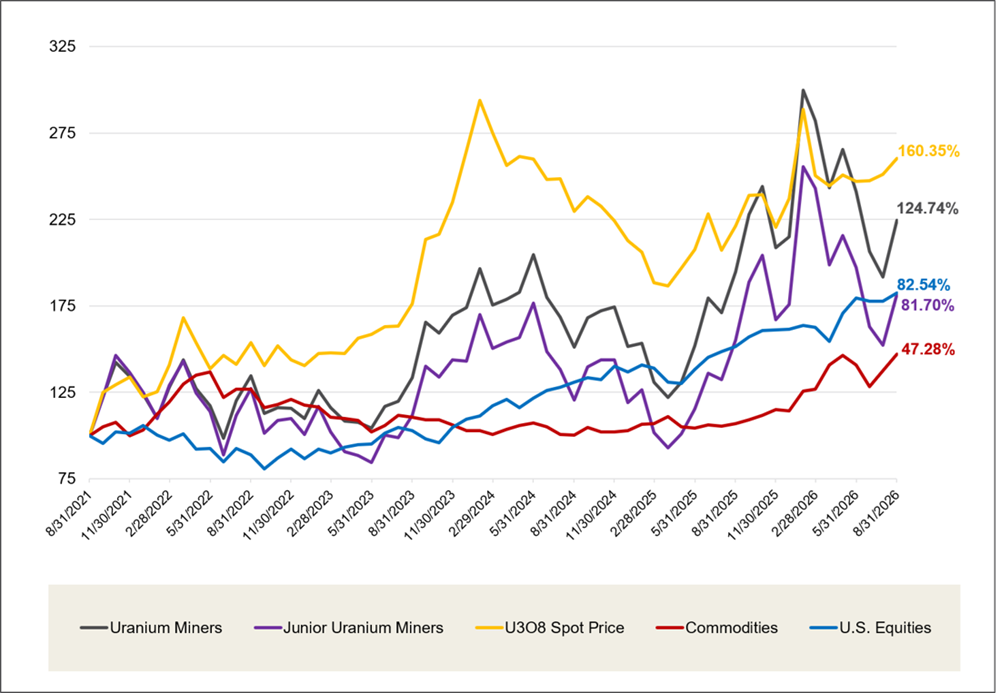
Looking at longer-term performance, uranium and uranium miners have meaningfully outpaced equities and broader commodity benchmarks over the past five years (Figure 2).
Figure 2. Physical Uranium and Uranium Stocks Have Outperformed Other Asset Classes Over the Past Five Years (8/31/2021-8/31/2026)
Source: Bloomberg and Sprott Asset Management. Data as of 8/31/2026. Uranium Miners are measured by the VettaFi Global Uranium Mining Index (URNMX index); Junior Uranium Miners are measured by the Nasdaq Sprott Junior Uranium Miners™ Index (NSURNJT™ Index); the S&P 500 TR Index measures U.S. Equities; the U3O8 uranium spot price is measured by a proprietary composite of U3O8 spot prices from UxC, S&P Platts, Numerco, and TradeTech LLC; and Commodities are measured by the Bloomberg Commodity Index (BCOM). Definitions of the indices are provided in the footnotes. You cannot invest directly in an index.
Sprottlight
From Ambition to Action
The 2026 World Nuclear Symposium delivered a constructive message for uranium as the industry shifted its attention from building support for nuclear expansion to financing, constructing and fueling that growth. Industry discussions indicated potential for increased activity from U.S. and European utilities, with several material requests for proposals expected following the conference. At the same time, producers remain focused on pricing discipline rather than maximizing near-term sales, creating a favorable setup as the uranium market enters its seasonally active contracting period.
The timing makes the symposium an important annual checkpoint for uranium. Market activity typically slows during the summer before utilities, producers, fuel-cycle companies, policymakers and investors from around the world gather in September to assess the industry's outlook. The conference then helps set the tone for the period when utility procurement and spot-market activity have historically increased through year-end. This year's gathering arrived with spot uranium emerging from its summer lull, the long-term price at a record and utilities facing substantial future requirements that have yet to be contracted.
The symposium's theme, "From Ambition to Action," captured a meaningful change in the discussion. The case for nuclear power has strengthened considerably in recent years, supported by rising electricity demand, energy security concerns and the need for dependable generation. Participants focused increasingly on the practical requirements for delivering forecasted growth, including financing, regulatory reform, standardized reactor designs, skilled labor and industrial capacity. For uranium, the implication is direct. As reactor ambitions progress toward investment and construction decisions, future fuel requirements must also translate into procurement and mine development.
Nuclear Expansion Meets Supply Constraint
The prospective scale of the expansion reinforces the challenge. Thirty-nine countries now support the pledge to at least triple global nuclear capacity by 2050. The World Nuclear Association estimates that reaching this target would require approximately US$6 trillion of investment and increase global nuclear capacity from around 440 GWe to nearly 1,457 GWe.6 Delivering on these ambitions will require greater cooperation between governments and private capital, more consistent regulatory frameworks, and repeatable reactor designs capable of lowering costs and construction risk.
Even partial delivery would require a major increase in fuel production. One of the most important observations at the conference was that conversion and enrichment capacity can be constructed, but uranium mine supply remains constrained by geology, project economics and lengthy development timelines. A reactor entering construction today will require uranium before it can begin commercial operation and will then continue consuming fuel for several decades. The mines needed to supply that reactor must therefore be identified, permitted, financed and constructed many years before the resulting demand appears in annual consumption figures.
Nuclear ambition is accelerating, but new uranium supply takes decades to deliver.
The 2026 edition of Uranium: Resources, Production and Demand, released in September and commonly known as the Red Book, reinforces this urgency. Uranium projects typically require 15 to 20 years to progress from identification through permitting and development.7 Although the world has identified sufficient resources to meet projected uranium demand through 2050, those resources cannot fuel reactors unless investment decisions are made well in advance. The issue is not an absence of uranium in the ground, but whether enough economic production can be brought online within the required timeframe.
The approaching contracting period is particularly important because U.S. and European utilities remain well covered in the near term, but their contract coverage declines sharply after 2030. Maximum European uranium coverage falls from 100% in 2030 to 36% by 2034, while U.S. coverage falls from approximately 60% to just 9% between 2030 and 2033.8 Because uranium must be contracted and processed years before it reaches a reactor, utilities will need to address these requirements well before the associated delivery years.
Despite the constructive tone, the conference did not suggest that delivery will be easy. Greenfield uranium projects continue to face long permitting periods, rising construction and financing costs, and a limited number of final investment decisions. Producers and developers remain focused on achieving acceptable returns rather than adding market share at insufficient prices. We believe that this discipline means that materially greater production is likely to require utilities to offer higher prices, longer contracts and better terms.
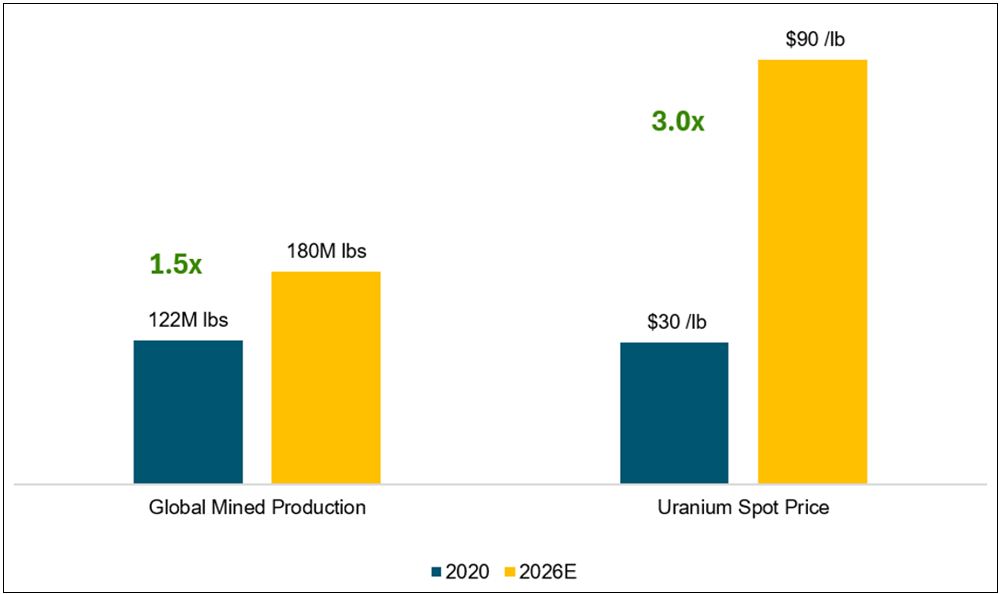
The uranium supply response to date illustrates the scale of the next challenge. Since 2020, uranium prices have approximately tripled while annual production has increased by roughly 60 million pounds, with most of that growth coming from restarts (Figure 3). If uranium prices have tripled while mine supply has increased by only 50%, it raises an important question about the pricing and contract terms required for production to grow commensurately with a tripling of global nuclear capacity. The next phase of supply growth will depend much more heavily on relatively higher-cost greenfield mines. These projects require more capital, take longer to develop and carry greater execution risk than the restarts that drove the recent production response, reinforcing the potential for continued upward price discovery as utilities seek to secure the required supply.
The central message from London was therefore that the industry is beginning to confront what it will take to deliver the targeted growth, and that uranium sits at the front of that process. The market is entering its seasonally active period with record term prices, extensive uncovered requirements and producers maintaining negotiating discipline. The next potential catalyst is whether that constructive outlook translates into contracts capable of supporting the next generation of uranium mines.
Figure 3. Uranium Prices Triple as Global Mine Production Rises 50% (2020-2026E)
Source: Bloomberg and UxC. Global Mined Production for 2026E is from the UxC Q3 Uranium Market Outlook. 2026E Uranium Spot Price represents the most recent uranium spot price, as of 09/17/2026. Uranium Spot Price is measured by the UxC Uranium U3O8 Spot Price (UXCPU308 UXCP Index).
The U.S. government is assessing a potentially significant new source of recurring demand for domestic uranium. The National Nuclear Security Administration (NNSA), which secures nuclear materials for U.S. military programs, is assessing purchases beginning as early as 2030. The uranium would include low-enriched uranium for tritium production and highly enriched uranium for naval nuclear propulsion plants.9
The potential demand is material relative to the domestic market. The NNSA expects its long-term requirements to reach approximately four million pounds of U.S.-origin U3O8 annually over a 10-year period. Imported uranium generally cannot satisfy the NNSA requirement because the material must be domestically sourced and free of foreign-use restrictions.
This annual requirement would represent ~100% of current U.S. production.
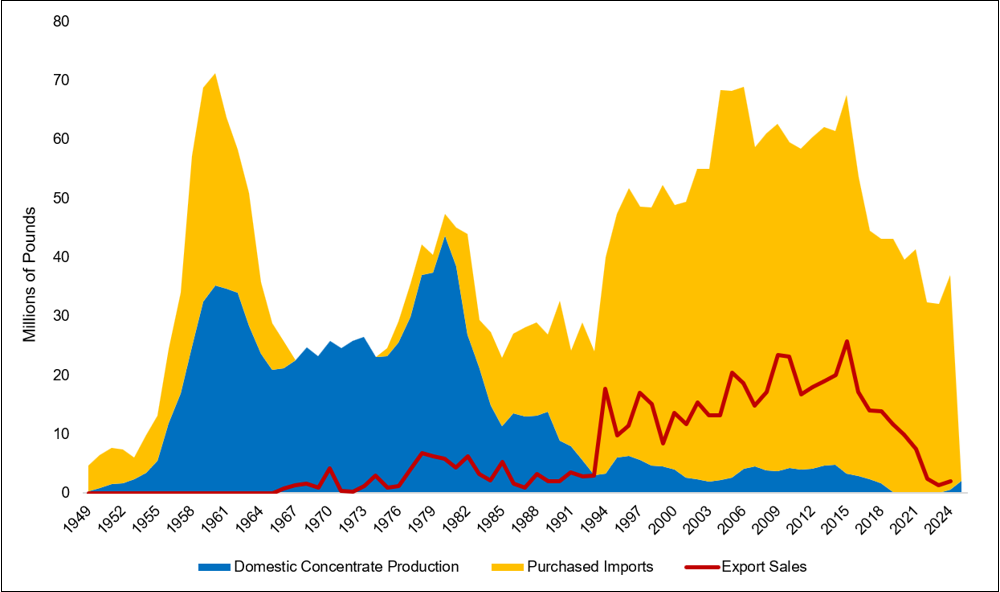
These planned purchases will compete directly with utility requirements, which are already heavily dependent on foreign supply. U.S. commercial reactors require approximately 49 million pounds of uranium annually, while domestic mines supply only a small fraction of that amount (Figure 4). Utility contract coverage also declines sharply after 2030.
Proposed U.S. government purchases could equal today’s entire domestic uranium production.
The potential procurement provides a tangible example of the U.S. moving from ambition to action. The government has already established the U.S. Strategic Uranium Reserve through purchases from domestic producers. At the same time, several uranium projects have entered FAST-41, a federal program designed to improve permitting coordination and predictability. The NNSA initiative could build on those efforts by creating additional recurring demand for newly mined U.S. uranium.
This combination may provide meaningful support for U.S. uranium miners. Greater demand visibility could encourage new mines, mine restarts and additional production, while FAST-41 may help advanced projects move through federal permitting more efficiently. The process remains preliminary and does not guarantee that contracts will follow, but it signals a shift from policy support toward the potential direct purchase of domestic uranium at a time when U.S. production remains well below domestic requirements.
Figure 4. U.S. Nuclear Energy Dependence (1949-2025)
Source: EIA January 2026 Monthly Energy Review. 2025 data shown for Domestic Concentrate Production. Purchased Imports and Export Sales are not available.
Looking Ahead: Momentum Meets a Tightening Market
The uranium market enters the final months of the year with several potential catalysts that could build on the momentum already evident in record term prices. The most immediate is the expected seasonal increase in utility contracting following the World Nuclear Symposium. A pickup in requests for proposals and completed contracts could support further price discovery as utilities seek dependable future production.
Inventories are unlikely to provide the same buffer they once did. Excess commercial inventories are no longer a significant source of supply, remaining holdings are increasingly strategic, and China has accounted for nearly all recent utility inventory growth. Continued efforts to reduce reliance on Russian uranium and fuel-cycle services may also encourage Western utilities to maintain larger inventories and secure supply further in advance. This shift from minimizing inventories toward greater supply security could bring additional demand into both the term and spot markets.
Tightening inventories and renewed contracting could intensify competition for future uranium supply.
Further reactor life extensions, restarts and new-build decisions could strengthen the demand outlook across multiple time horizons. Final investment decisions for new U.S. reactors would be particularly notable, while continued progress in Asia and emerging advanced-reactor technologies would broaden the future fuel requirement.
The combination remains constructive for uranium and uranium miners. Contracting activity may provide the next near-term catalyst, while tightening inventories, strategic government demand and potential supply disruptions could increase competition for available material. Over the longer term, growing reactor requirements continue to converge with a supply base that is concentrated, difficult to expand and increasingly dependent on higher-cost greenfield mines. These dynamics may support continued uranium price discovery and improving economics across existing producers and advanced development projects.
Beyond these near-term catalysts, uranium's bull market remains supported by a broadening demand base. Rising electricity consumption, including from data centers and artificial intelligence, is increasing the value of reliable, around-the-clock nuclear generation, while energy-security priorities continue to strengthen government support for nuclear power and secure fuel supply. Uranium demand is also relatively insensitive to higher prices because fuel represents a small share of reactor operating costs. With requirements growing across the existing and future reactor fleet, inventories becoming scarcer, and new mine supply remaining slow and capital-intensive to develop, the structural backdrop continues to support uranium prices and improve economics for uranium miners.
Figure 5. Uranium Bull Market Continues (1968-2026)
View Larger PDF Version of This Chart
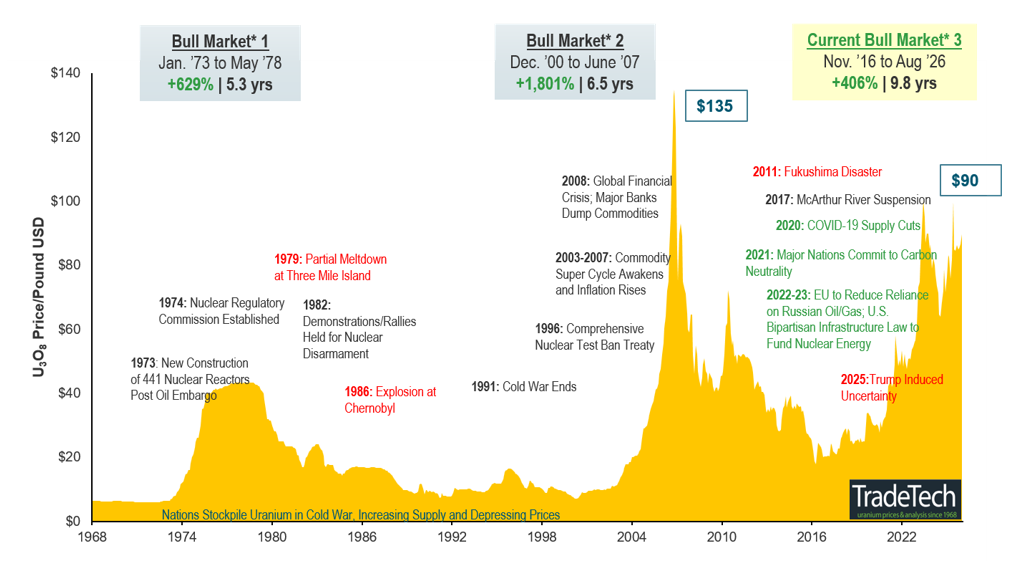
Note: A “bull market” refers to a condition of financial markets where prices are generally rising. A “bear market” refers to a condition of financial markets where prices are generally falling. Source: TradeTech Data as of 08/31/2026. TradeTech is the leading independent provider of uranium prices and nuclear fuel market information. The uranium prices in this chart, dating back to 1968, are sourced exclusively from TradeTech; visit https://www.uranium.info/.
Footnotes
| 1 | The U3O8 uranium spot price is measured by a proprietary composite of U3O8 spot prices from UxC, S&P Platts, Numerco and TradeTech LLC. |
| 2 | The VettaFi Global Uranium Mining Index (URNMX) was created by North Shore Indices, Inc. (the “Index Provider”). The index was acquired by VettaFi, a differentiated index provider with modern distribution solutions and a subsidiary of TMX Group, and as of 4/30/2026 it was renamed the VettaFi Global Uranium Mining Index. VettaFi is responsible for the ongoing maintenance of the Index. The Index is calculated by VettaFi, which is not affiliated with the North Shore Global Uranium Miners Fund (“Existing Fund”), ALPS Advisors, Inc. (the “Sub-Adviser”) or Sprott Asset Management LP (the “Adviser”). |
| 3 | The Nasdaq Sprott Junior Uranium Miners™ Index (NSURNJ™) was co-developed by Nasdaq® (the “Index Provider”) and Sprott Asset Management LP (the “Adviser”). The Index Provider and Adviser co-developed the methodology for determining the securities to be included in the Index and the Index Provider is responsible for the ongoing maintenance of the Index. The Adviser will provide certain services in connection with the Index, including contributing inputs in connection with the eligibility and process to determine the initial selection and ongoing composition of the Index constituents. |
| 4 | The Bloomberg Commodity Index (BCOM) is a broadly diversified commodity price index that tracks prices of futures contracts on physical commodities and is designed to minimize concentration in any one commodity or sector. It currently has 23 commodity futures in six sectors. |
| 5 | The S&P 500 or Standard & Poor's 500 Index is a market-capitalization-weighted index of the 500 largest U.S. publicly traded companies. |
| 6 | Source: WNA, World Nuclear Outlook Report 2026 Full Document, 9/06/2026. |
| 7 | Source: IAEA, Adequate uranium resources available, but sustained investment essential to support global nuclear capacity growth, 9/14/2026. |
| 8 | Source: Sprott Insights, On the Cusp of a New Contracting Cycle, 8/18/2026. |
| 9 | Source: Highergov.com, Request for Information NNSA Uranium Acquisition, 8/10/2026. |


Investment Risks and Important Disclosure
Relative to other sectors, precious metals and natural resources investments have higher headline risk and are more sensitive to changes in economic data, political or regulatory events, and underlying commodity price fluctuations. Risks related to extraction, storage and liquidity should also be considered.
Gold and precious metals are referred to with terms of art like "store of value," "safe haven" and "safe asset." These terms should not be construed to guarantee any form of investment safety. While “safe” assets like gold, Treasuries, money market funds and cash generally do not carry a high risk of loss relative to other asset classes, any asset may lose value, which may involve the complete loss of invested principal.
Past performance is no guarantee of future results. Investments, commentary and statements are unique and may not be reflective of investments and commentary in other strategies managed by any other Sprott entity or affiliate. Opinions expressed in this presentation are those of the presenters and may vary widely from opinions of other Sprott affiliates. Forward-looking language should not be construed as predictive. While third-party sources are believed to be reliable, Sprott makes no guarantee as to their accuracy or timeliness. This information does not constitute an offer or solicitation, nor an investment advice or recommendation, and may not be relied upon or considered to be the rendering of tax, legal, accounting or professional advice.