

Key Takeaways
- Gold Miners Surge Back: Following a sharp Q2 correction, Q3 kicked off a powerful resurgence for gold miners, as growing concerns over fiscal deficits and currency debasement sparked a surprise 30% rally in August.2
- Stronger Fundamentals, Unrecognized Value: While gold miners are on their strongest financial footing in decades, valuation multiples have not rewarded record earnings, strong balance sheets and improved capital discipline.
- Scarce Gold Reserves: A structural decline in new gold reserve discoveries may increasingly constrain future mine supply, potentially placing a premium on miners and explorers able to secure high-quality reserves.
Performance as of September 30, 2026: Average Annual Total Returns
| Metric | YTD | 1 YR | 3 YR | 5 YR | 10 YR | 20 YR |
| Gold Bullion2 | -3.75% | 7.73% | 31.02% | 18.80% | 12.19% | 10.18% |
| NYSE Arca Gold Miners Index (GDM)3 | 4.65% | 20.34% | 52.54% | 27.97% | 15.08% | 6.33% |
Source: Bloomberg and Sprott Asset Management LP. Periods of less than one year are not annualized. Data as of 9/30/2026. Performance data quoted represents past performance. Past performance does not guarantee future results. Current performance may be higher or lower than actual data quoted. The NYSE Arca Gold Miners Index (GDM) is a rules-based index designed to measure the performance of highly capitalized companies in the hold mining industry. You cannot invest directly into an index.
Figure 1. Gold Miners Have Provided Leverage to a Rising Gold Price (2021-2026)
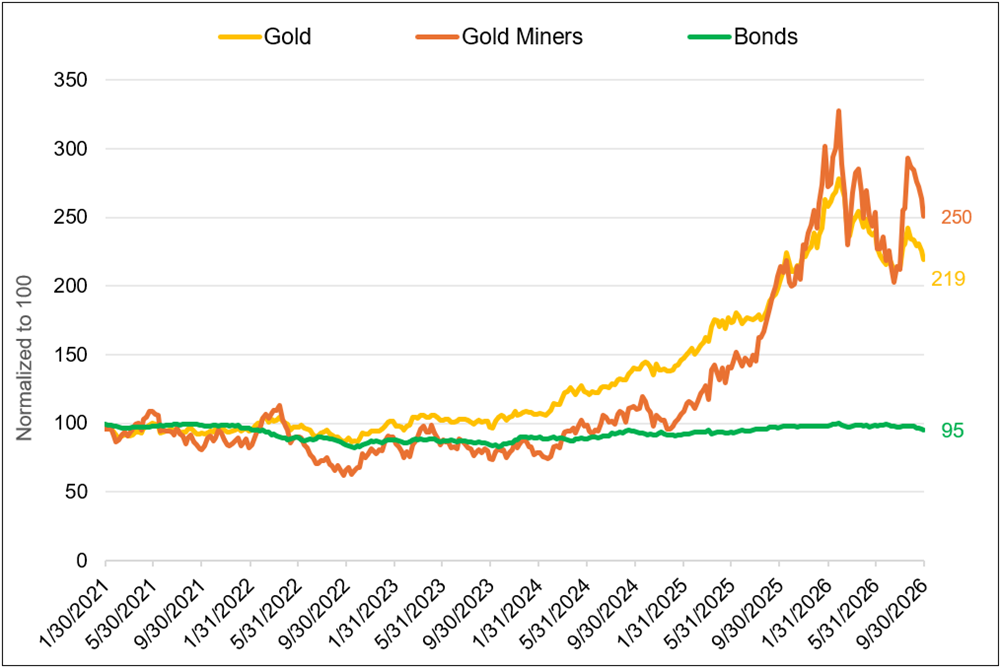
Source: Bloomberg. Data for the period 12/31/2020-9/30/2026. Gold is measured by Bloomberg GOLDS Comdty index; gold miners are measured by the NYSE Arca Gold Miners Index (GDM); bonds are measured by the Bloomberg Barclays US Agg Total Return Value Unhedged USD (LBUSTRUU Index).
Overview: How Gold Has Performed in 2026, a Tale of Two Markets
We view gold's year-to-date performance as a tale of two markets, each with its own distinct drivers: The first was driven by concerns about U.S. dollar debasement and reserve diversification. These tailwinds helped propel gold to its all-time high of $5,595 per ounce in January. The second has been shaped by energy supply disruptions, inflation fears and Federal Reserve (Fed) interest rate expectations. In our view, the former reflects gold's longer-term underlying structural support trend, while geopolitical supply shocks exert greater influence on the latter.
Fiscal concerns are renewing the case for gold and gold miners.
The regime change occurred immediately after the outbreak of the U.S.-Iran war, triggered by an energy supply shock that shifted real interest rates and inflation concerns back into the driver's seat. This prompted profit taking in gold and contributed to a 25.3% peak-to-trough drawdown from March 2 through July 16, 2026. As investors increasingly priced in the inflationary impact of a prolonged Middle East energy war, attention turned back to Fed policy, which strengthened the U.S. dollar and created significant headwinds for gold.
Figure 2. Inflation Expectations Strengthen the U.S. Dollar and Weigh on Gold Prices (2025-2026)
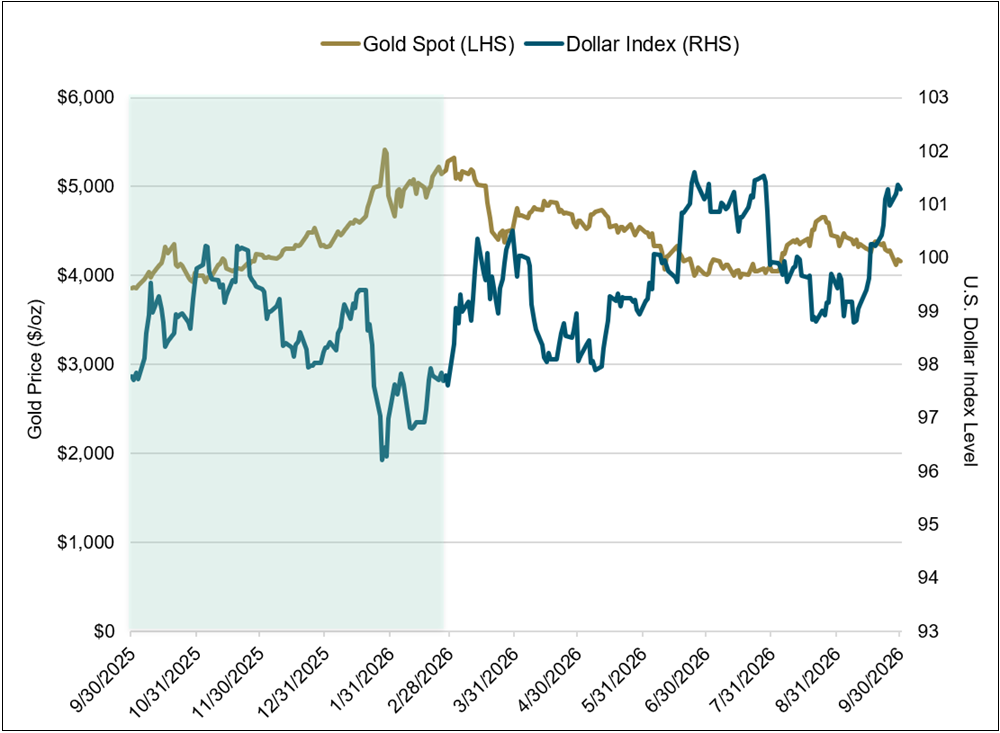
Source: Bloomberg (9/30/2025 - 9/30/2026). Gold United States Dollar Spot and Dollar Index (DXY).
The narrative pivoted again in August as sovereign debt risks re-emerged and the debasement trade sent precious metals higher. Softer inflation data, a weaker dollar and renewed debate over fiscal risks helped revive the largely neglected gold mining sector, driving one of its strongest advances on record. The rally was initially sparked by a coordinated U.S.-Japan intervention in the yen and later reinforced by the U.S. Treasury Department's decision to double its long-term bond buybacks. Together, these measures intensified debate over sovereign balance sheets and the sustainability of deficit spending. While the effectiveness remains debated, the market reaction was decisive: the U.S. dollar weakened and gold mining stocks climbed 32% in August.4
While macroeconomic developments continue to drive short-term volatility, we view these as cyclical swings within a broader structural trend. Recent performance in precious metals suggests that investors may be placing greater value on gold as a hedge against rising fiscal and monetary devaluation risks.
We believe these implications may extend beyond bullion to the mining companies that produce it. Yet many gold mining stocks continue to trade at valuations that appear inconsistent with their underlying fundamentals, despite generating near-record earnings, cash flow and distributions, attributes that physical bullion does not offer.
Connecting the Dots: The Case for Gold Miners
While the August recovery reignited interest in the gold mining sector, the most compelling story may be the disconnect between fundamentals and valuations. Since 2016, earnings expectations for gold miners have recovered sharply, breaching new highs in 2026. At the same time, forward valuation multiples have steadily compressed over the past decade, suggesting that valuations have not priced in improvements to their underlying economics. Twelve-month EPS expectations have risen nearly fourfold, reaching as high as $219.77 on September 30, 2026, from ~$49.60 at the end of 2023. Meanwhile, forward EV/EBITDA multiples have compressed to 5.7X, down from a peak of 9.9X in June 2014.5
Gold miners’ fundamentals have improved, but valuations have not caught up.
Historically, stronger earnings prospects have generally been accompanied by expanding valuation multiples. Yet the opposite has occurred in the gold mining industry, where valuations continue to imply a far weaker outlook than current fundamentals suggest. Although the conditions that drove a decade of multiple compression appear to be reversing, we note that valuation multiples have yet to reflect the improvement. While macroeconomic headwinds weighed on sentiment through much of 2026, the disconnect between earnings and valuations suggests that many investors continue to view gold miners through the lens of the prior cycle rather than today’s fundamental reality.
Figure 3. Gold Miners Valuations Remain Compressed Despite Rising Earnings Expectations (2006-2026)
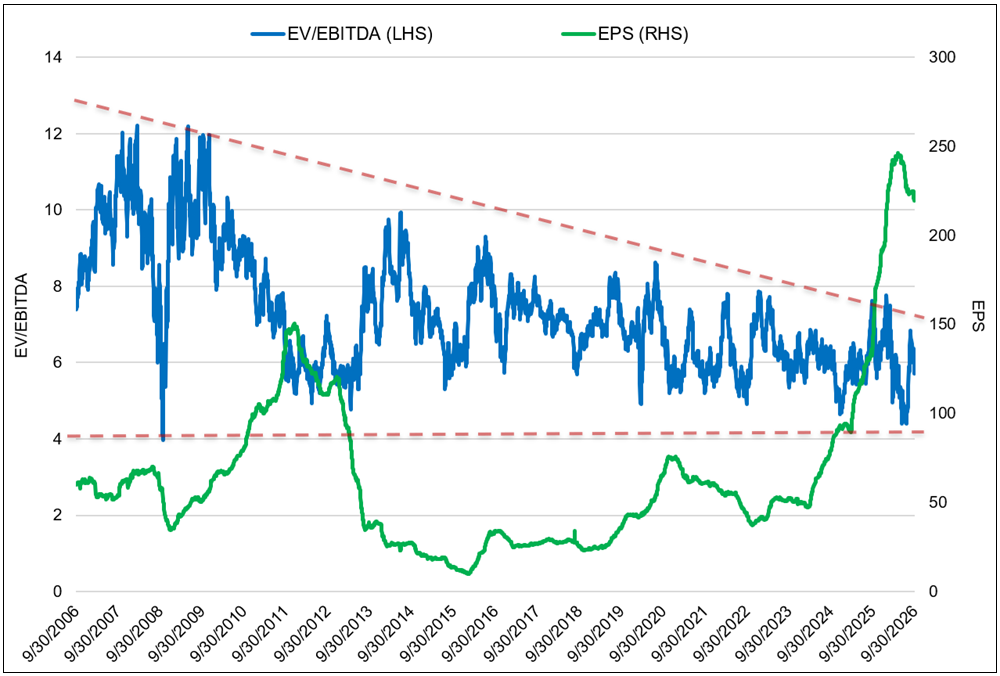
Source: Data from 9/30/06-9/30/26. EV/EBITDA and EPS metrics are 12-month rolling-forward average estimates for the NYSE Arca Gold Miners Index.
Gold Miners 2.0: Are Market Perceptions Outdated?
Investor skepticism toward gold miners is understandable. The 2011 bull market in precious metals was punctuated by aggressive expansion and value-destroying M&A (mergers and acquisitions) that culminated in a daisy chain of write-downs and reorganizations from 2012 to 2017, erasing as much as $129 billion in shareholder value.6
While it's important to retain the lessons of the past, we would argue that many of the characteristics that defined the 2011 cycle are absent today. After a decade of reorganizations and disappointing returns, shareholders have become far less tolerant of debt financing, pushing management teams to prioritize profitability and capital discipline over growth-at-any-cost strategies. Consequently, gold mining companies have been more selective in pursuing large-scale expansion projects and M&A. One of the clearest manifestations of this shift is capital spending. Unlike the 2011 cycle, when capital expenditures rose in tandem with earnings, earnings growth has significantly outpaced capex, with the difference flowing into profits, cash flows and shareholder distributions.
Growth-at-any-cost has been replaced with capital discipline and healthier balance sheets.
The impact of this shift is evident in gold mining industry financials, as management teams have increasingly directed record earnings toward strengthening balance sheets and returning capital to shareholders. Many producers now maintain net cash positions, while debt has declined and returns on capital have risen, reflecting a greater reliance on internally generated cash flow rather than new borrowing. Shareholder distributions and returns on capital are now multi-decade, if not all-time, highs. In our view, these characteristics stand in stark contrast to the debt-fueled expansion cycle of the early 2010s.
While these fundamental shifts may help explain why investor perceptions continue to lag industry fundamentals, persistently discounted valuations suggest that the market remains unconvinced that these changes are permanent. In other words, the market appears to view recent improvements in profitability, balance sheet strength and capital discipline as cyclical rather than structural. However, if these industry improvements prove lasting and gold prices remain supported, the gap between investor perception and industry fundamentals may become increasingly difficult to justify.
Figure 4. Gold Miners Are Generating Higher Returns, Returning More Capital and Sitting on Cash (2006-2026)
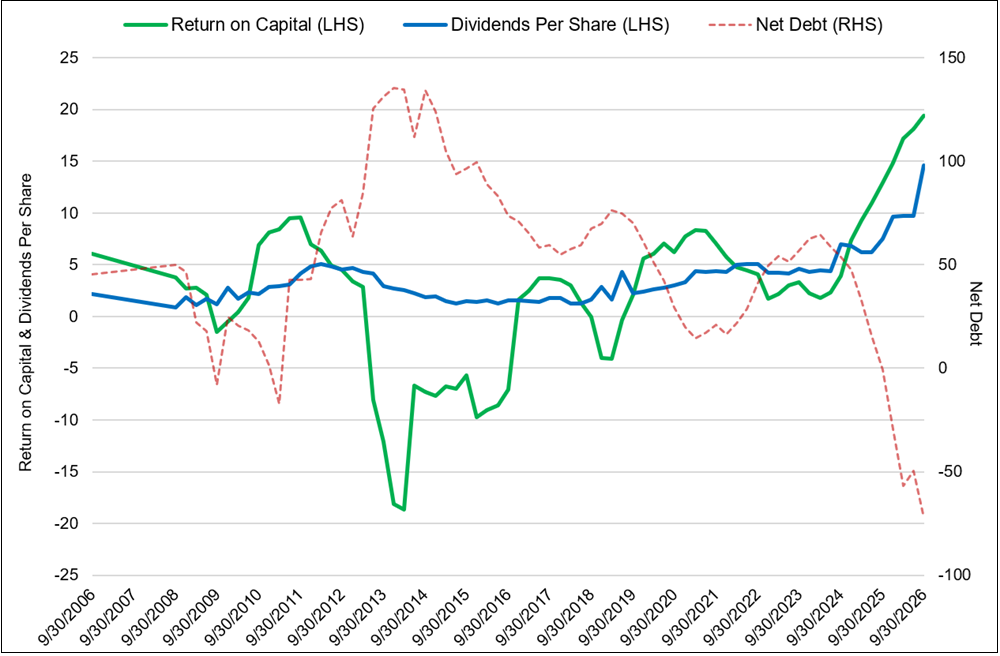
Source: Data for the period 9/30/06-9/30/26. Return on Capital, Dividends Per Share and Net Debt metrics on the NYSE Arca Gold Miners Index (GDM).
Gold Miners Outlook: The Rising Scarcity of Gold Reserves
Looking ahead, we believe the shrinking reserve base of the gold mining industry may prove just as important as its improving financial profile. Despite record-high gold prices and a gradual recovery in exploration spending, major new gold discoveries remain scarce in the post-COVID-19 era.7 Evidence suggests that this challenge extends well beyond the last cycle; major mine discoveries have trended downward since the 1990s and have remained elusive even as exploration budgets have grown. The resulting divergence suggests that the industry is finding it increasingly difficult to replace depleted reserves, raising questions about future growth in mined supply even as global demand for gold remains near record levels.8
Part of the explanation may lie in how miners have deployed capital. In recent years, most new reserve additions have originated from known brownfield deposits. While brownfield projects can reduce execution risk, greenfield exploration has historically been responsible for most major gold deposit discoveries. Yet even the surge in exploration budgets during the 2011 cycle failed to reverse the long-term decline in gold discoveries, instead largely offsetting reserves depleted through production and divestitures.9
High-quality gold reserves are increasingly scarce.
Several factors appear to be driving this trend. The industry continues to face rising development costs, declining ore grades and mounting jurisdictional risks. As economically viable discoveries in favorable mining regions become scarce, miners have transitioned to deeper deposits and less-established jurisdictions. As a result, replacing reserves has become more costly, technically complex and subject to greater permitting and political risks. These pressures have further reinforced the industry's preference for brownfield expansions and incremental ramp-ups rather than large-scale greenfield development.
In our view, these dynamics elevate the strategic value of high-quality gold reserves and reinforce the importance of asset quality as economically viable gold ounces become increasingly difficult to replace. The implications extend beyond individual assets and into the industry’s long-term gold supply outlook. Rising technical, logistical and jurisdictional challenges are reflected in the lengthening of the mine development process, with the average timeline from discovery to production increasing to 18 years, up from 6.4 years in 1999.10 These extended development timelines underscore the growing complexity of bringing new gold mines online but may further constrain the industry's ability to respond promptly to future demand growth.
Figure 5. Exploration Budgets Remain Intact, but Major Gold Discoveries Remain Scarce (1990-2025)
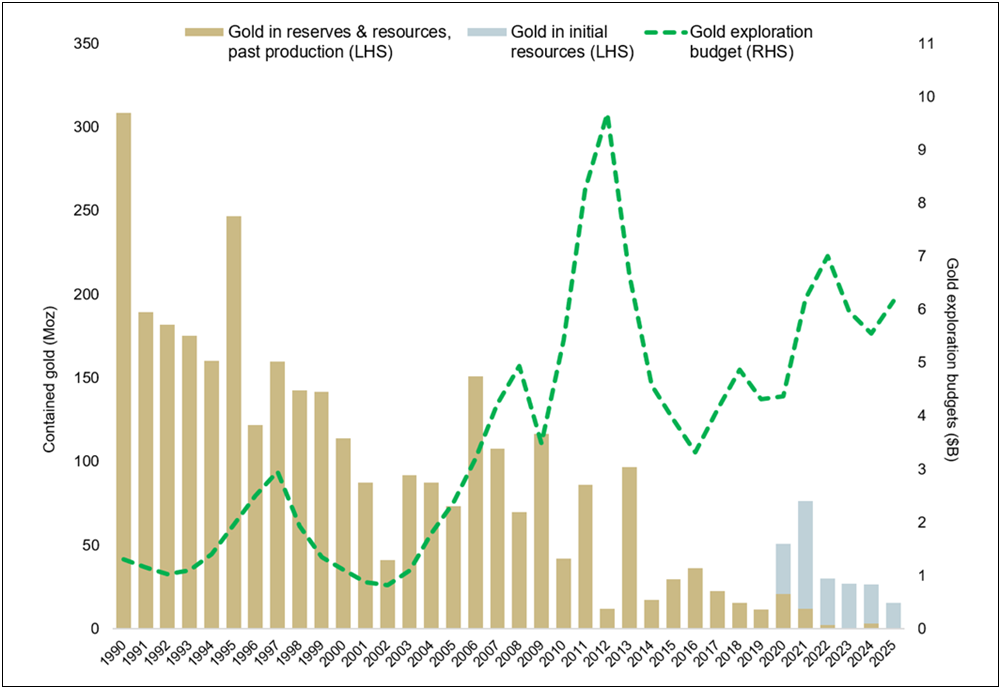
Source: S&P Global Market Intelligence. Major gold discoveries from 1990 to 2025. Data as of 8/6/2026.
Portfolio Positioning for the New Era in Gold Mining
As economically viable ounces of gold become harder to discover and develop, we believe the market may place a greater premium on producers with strong balance sheets, high-quality reserves, and disciplined management teams. Improved industry fundamentals and a shrinking pipeline of new discoveries paint a materially different picture from the one many investors remember from the previous 2011 cycle. In this environment, we believe the risk/reward dynamics may increasingly favor gold miners over bullion, as operating leverage, earnings growth and cash flow generation offer additional sources of return beyond changes in the gold price alone.
In an environment of rising geological complexity, permitting challenges and jurisdictional risks, the gap between winners and losers may widen. Active managers may be uniquely positioned to identify companies with superior reserve quality, project economics and management execution.
Gold miners may offer more than gold-price leverage in an era of reserve scarcity.
Junior miners and gold explorers offer direct exposure to the discovery side of the reserve-scarcity equation. As the industry contends with the structural decline in new major gold discoveries, companies that successfully define and advance economic deposits may become increasingly valuable to larger producers seeking to replenish reserves. While inherently higher risk, junior miners have historically provided meaningful leverage to rising gold prices: a stronger gold price can improve project economics, expand the value of undeveloped resources and increase access to capital. They may also benefit from renewed M&A activity as senior producers seek growth through acquisition.
Today’s gold mining industry bears little resemblance to the one investors experienced a decade ago. Greater capital discipline, stronger balance sheets and an increasingly constrained reserve-replacement pipeline have reshaped the industry's fundamentals. These characteristics appear particularly compelling amid sustained gold demand from central bank buying, concerns about currency debasement and expanding fiscal deficits. If gold's long-term monetary drivers remain intact, the disconnect between industry fundamentals and current valuations may become increasingly difficult to ignore.
Footnotes



Investment Risks and Important Disclosure
Relative to other sectors, precious metals and natural resources investments have higher headline risk and are more sensitive to changes in economic data, political or regulatory events, and underlying commodity price fluctuations. Risks related to extraction, storage and liquidity should also be considered.
Gold and precious metals are referred to with terms of art like "store of value," "safe haven" and "safe asset." These terms should not be construed to guarantee any form of investment safety. While “safe” assets like gold, Treasuries, money market funds and cash generally do not carry a high risk of loss relative to other asset classes, any asset may lose value, which may involve the complete loss of invested principal.
Past performance is no guarantee of future results. Investments, commentary and statements are unique and may not be reflective of investments and commentary in other strategies managed by any other Sprott entity or affiliate. Opinions expressed in this presentation are those of the presenters and may vary widely from opinions of other Sprott affiliates. Forward-looking language should not be construed as predictive. While third-party sources are believed to be reliable, Sprott makes no guarantee as to their accuracy or timeliness. This information does not constitute an offer or solicitation, nor an investment advice or recommendation, and may not be relied upon or considered to be the rendering of tax, legal, accounting or professional advice.