

For the latest standardized performance and holdings of Sprott ETFs, please visit the individual website pages: METL and REXC. Past performance is no guarantee of future results.
Key Takeaways
- Rare Earths Are a Defense Imperative: Rare earths are essential to advanced military systems, while rising defense spending and modernization are increasing their strategic importance.
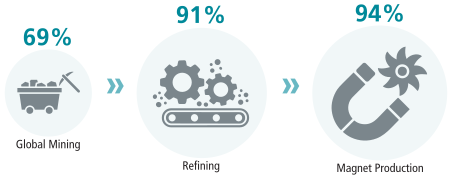
- China Dominates the Supply Chain: China’s advantage extends well beyond mining, accounting for 91% of magnet rare earth refining and 94% of finished rare earth magnet production in 2024.
- The Bottleneck Is Secure Supply: The challenge is not simply access to rare earth ore but building integrated mine-to-magnet supply chains capable of operating outside China.
- Policy Is Reshaping the Opportunity: Government price support, long-term offtake agreements and financing are helping improve the economics of ex-China capacity, expanding the investment opportunity across the rare earth value chain.
The New Era of Resource Security
A magnet temporarily grounded the world's most advanced fighter jet.
Not a software failure. Not an engine defect. A magnet containing a Chinese-sourced alloy halted deliveries of the F-35 fighter jet, exposing a hard reality: even a $30 billion defense program is only as resilient as its material supply chain.
The global economy is entering a new era of resource competition. As supply chains become more fragmented and nations shift from decades of "just-in-time" efficiency toward "just-in-case" resilience, secure access to critical materials is becoming a strategic imperative. Countries that cannot secure the raw materials their economies depend on risk losing economic competitiveness, technological leadership and ultimately national autonomy.
Resource security is national security.
Few materials illustrate this shift more clearly than rare earth elements. These specialized minerals enable many of the technologies shaping the modern economy, from electric vehicles, robotics and advanced consumer electronics to wind turbines, artificial intelligence infrastructure and next-generation industrial automation. As a result, rare earths have become just as important to corporate boardrooms and capital markets as they are to policymakers and military planners.
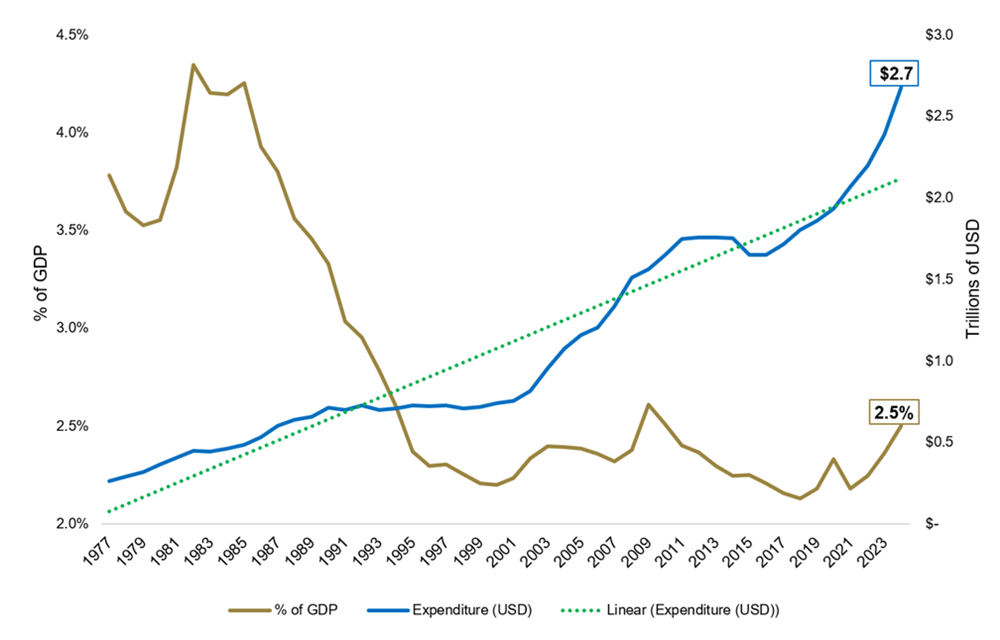
Yet nowhere is the importance of rare earth supply more apparent than in defense and national security. Rare earths are foundational to modern defense technology, and their strategic importance is rising as governments modernize military capabilities and rebuild critical supply chains. Global defense spending now exceeds $2.7 trillion annually,1 as shown in Figure 1.
Figure 1. World Defense Spending is Increasing (1977-2025)
Source: World Bank Group 10/29/2025 and Yearbook: Armaments, Disarmament and International Security, Stockholm International Peace Research Institute (SIPRI).
The U.S. Department of Defense requires an estimated 3,000-4,000 tonnes of specialized rare earth magnets annually, a figure expected to rise to 10,000 tonnes by 2030.2 While that may seem small relative to a roughly 250,000-tonne global market, it is significant compared with just 20,000-25,000 tonnes of ex-China rare earth magnet production today.
At the same time, rare earth supply chains remain highly concentrated and dominated by China. Governments are responding by pursuing greater supply security and investing in domestic and allied production.
Figure 2. China’s Rare Earth Dominance
Source: International Energy Agency (IEA), Rare Earth Elements: Executive Summary (2025); U.S. Geological Survey (USGS), Mineral Commodity Summaries: Rare Earths (2025). Sprott Asset Management.
Why Rare Earths Matter for Military Technology
Rare earths have magnetic, optical and thermal properties that can be difficult to replicate with alternative materials without sacrificing performance, weight or reliability.
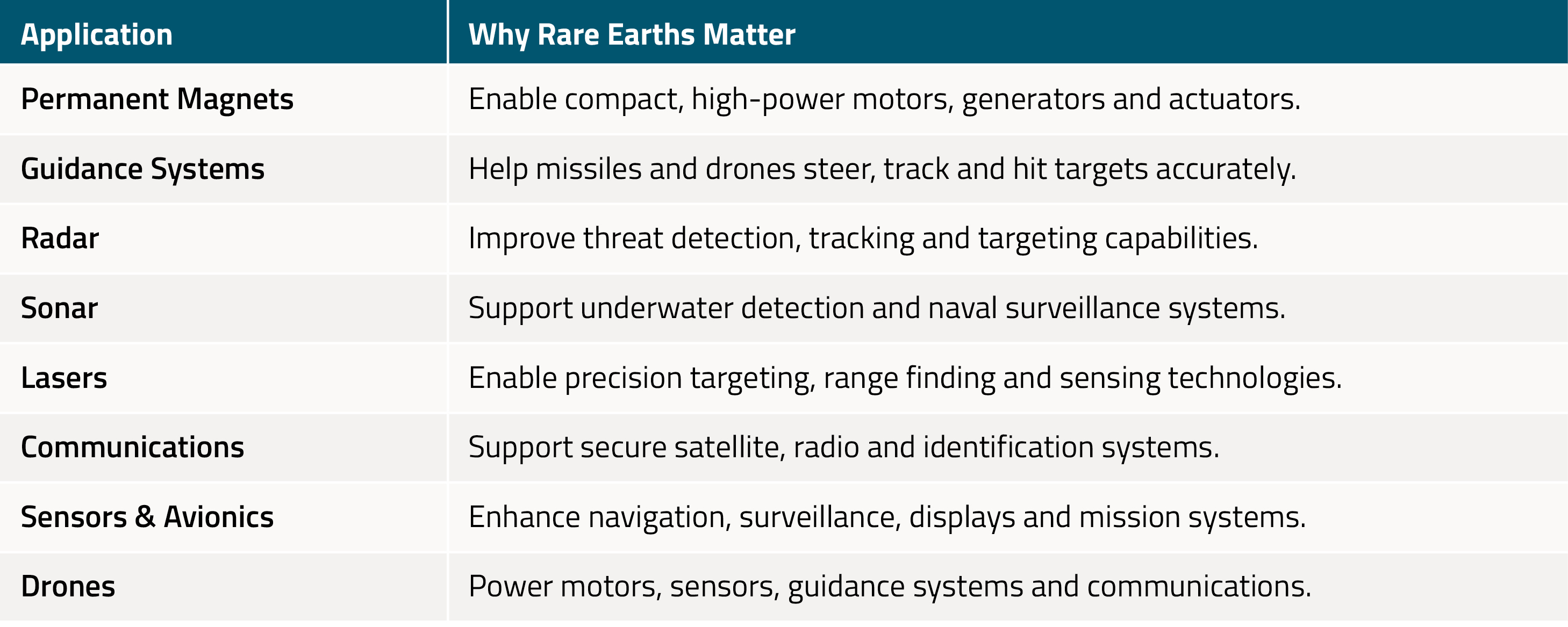
Rare earth permanent magnets are particularly important because they enable compact, lightweight and high-power motors and actuators. Advanced sensors, precision-guided munitions, autonomous systems and directed-energy technologies also rely on the specialized properties rare earths provide.
Rare earth-enabled components are embedded across modern defense systems. The U.S. Department of Defense cites rare earth magnet applications across the F-35, Virginia- and Columbia-class submarines, uncrewed aerial vehicles, Tomahawk missiles, radar systems and JDAM smart bombs.
Figure 3. Rare Earth Defense Applications
Source: U.S. Department of Defense, “DOD Looks to Establish ‘Mine-to-Magnet’ Supply Chain for Rare Earth Materials,” March 11, 2024; Congressional Research Service, Rare Earth Elements in National Defense.
Defense Modernization Is Fueling Critical Materials Demand
With geopolitical tensions rising and weapons systems becoming more technologically advanced, global defense spending is increasing. NATO has classified rare earth elements among its 12 defense-critical raw materials and pledged to raise defense spending to 5% of GDP by 2035.3
The composition of that spending also matters. Warfare is becoming more electrified, autonomous and sensor-driven, requiring greater use of advanced electronics, precision systems and high-performance components.
Reliability and source of supply matter more than cost to this buyer. In a market where China administers rare earth prices through quotas and export controls, the U.S. is carving out a parallel market in which supply security can take precedence over prevailing market prices.
The amount of rare earth material embedded in individual defense platforms illustrates this importance:
Figure 4. REE Content in Major U.S. Defense Platforms

Source: Benchmark Mineral Intelligence; Visual Capitalist, “Visualizing How Rare Earths Power U.S. Defense,” July 20, 2025.
The F-35: A Case Study in Rare Earth Dependence
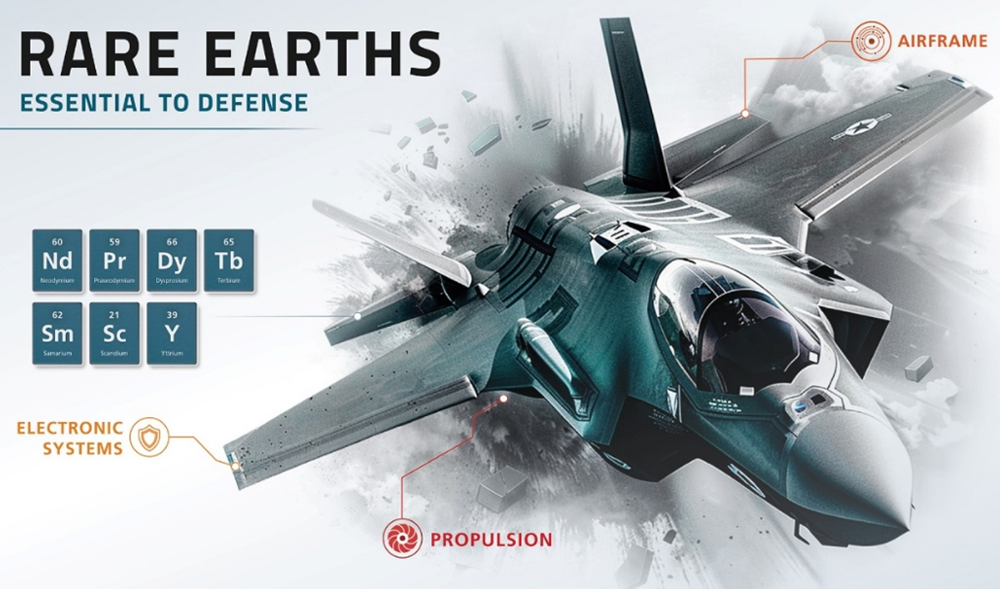
The Lockheed Martin F-35 Lightning II fighter jet provides a useful example of how rare earths are embedded across advanced military technology. Rare earth elements support propulsion, electronic and sensor systems, while specialized alloys contribute to aerospace applications.
The F-35 also highlights an important point about rare earth supply security: the challenge extends well beyond mining, and each step of the process creates another potential point of supply-chain dependence.
That vulnerability became apparent in 2022, when deliveries of new F-35s were temporarily halted after a Chinese-sourced alloy used in an engine magnet was discovered within the aircraft’s supply chain. The F-35 incident was not an isolated event. In 2025, China introduced export controls on several heavy rare earths and related magnets, demonstrating how reliance on a single dominant supplier can create vulnerabilities for defense manufacturers and governments seeking secure access to critical materials.
Figure 5. Rare Earths in the F-35 Fighter Jet
Source: Sprott Asset Management. See Rare Earths Essential to Defense, 7/09/2026.
China’s Dominance Extends Beyond Mining
China’s position in rare earths is often described in terms of mine production, but the more significant strategic bottlenecks exist further downstream. Rare earth production involves multiple stages, including mining, separation, refining, metal and alloy production and magnet manufacturing. China has built substantial capacity and expertise across nearly every stage. According to the International Energy Agency, China refined 91% of the world’s magnet rare earths and produced 94% of finished rare earth magnets in 2024.4
A new mine does little to strengthen supply security if its output must still be sent to China for processing or magnet manufacturing. For investors, the critical constraint is not the availability of rare earth resources, but the lack of secure, integrated supply chains capable of turning those resources into finished products.
Figure 6. Mine-to-Magnet Supply Chain
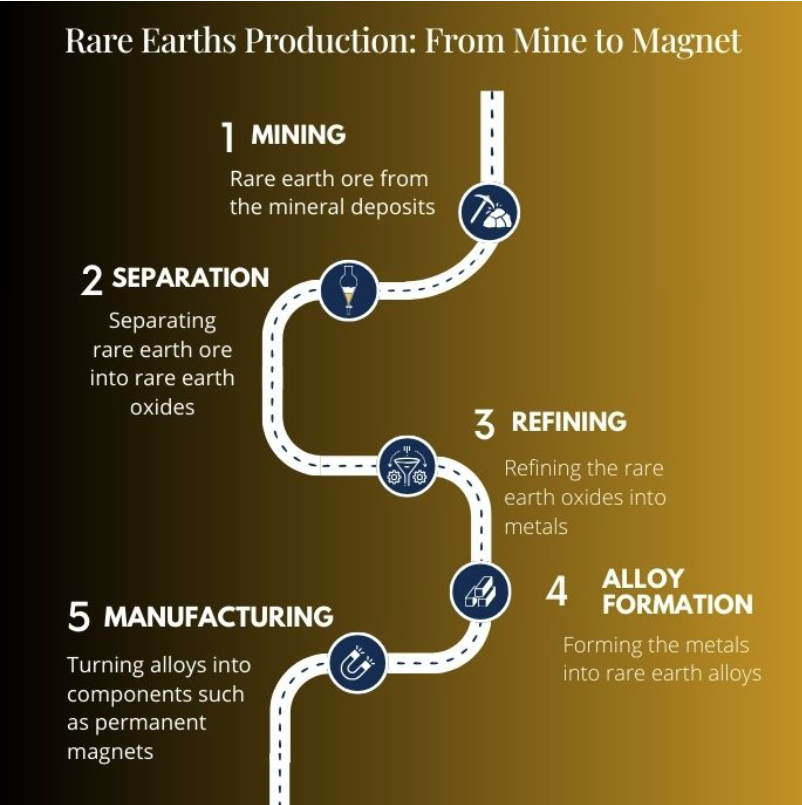
Source: Newsecuritybeat.com, Mine the Tech Gap: Why China’s Rare Earth Dominance Persists, 8/29/2024.
Building Mine-to-Magnet Supply Chains Outside China
Many governments and industries are now focusing on building integrated rare earth supply chains outside China. Processing and refining rare earth concentrates into usable materials is highly technical and specialized, requiring new facilities, skilled expertise and significant investment. Rebuilding these capabilities, including magnet manufacturing, will take time, capital and sustained cooperation between governments and industry.
U.S. policy is shifting from supporting rare earth projects to helping make the domestic supply chain economically viable.
This creates both an opportunity and a challenge. New supply must overcome permitting requirements, high capital costs, technical complexity, long development timelines and commodity-price volatility. But identifying a resource as strategic does not make every project economic. Some projects will require government support to proceed.
Since 2020, the U.S. Department of Defense has awarded more than $439 million to help establish domestic rare earth supply chains, including separation, refining, rare earth metals and magnet manufacturing.5
In 2025, the Department of Defense (DoD) agreed to a $110/kg price floor for MP Materials’ NdPr (Neodymium-Praseodymium) products, insulating the company from market prices below that level in exchange for helping secure the domestic supply. In addition, the DoD signed a 10-year 100% offtake agreement for all magnets produced at MP’s planned 10X facility and supported a broader financing package tied to expanding U.S. magnet capacity.6 The DoD agreement came with a significant condition: MP Materials would cease all sales to China, underscoring the critical objective of building a rare earth supply chain independent of China.
In August 2026, the Department of Defense launched a $1.55 billion initiative to strengthen critical mineral supply chains, including a $750 million investment in Brazil’s rare earth production and processing capacity. The effort is intended to improve supply chain resilience and reduce reliance on concentrated sources of supply.
U.S. policy is evolving beyond funding new capacity toward price support, long-term offtake and financing designed to improve project economics and reduce investment risk.
Investing in the Ex-China Buildout
As demand from defense, AI infrastructure, electrification and advanced manufacturing grows, the race to build ex-China capacity is creating opportunities across the industry, from developers bringing new projects online to companies expanding processing and manufacturing capabilities.
Not every company will benefit equally. Asset quality, execution, cost structure and exposure to specific rare earth markets will separate the winners from the rest. But the direction of travel is clear: governments and industry are committing unprecedented capital and policy support to reduce dependence on China and establish viable sources of rare earth production, processing and manufacturing elsewhere.
Access Rare Earth Companies with Sprott
For investors looking to participate in this trend, Sprott offers exposure across the critical materials ecosystem. The Sprott Rare Earths Ex-China ETF (Nasdaq: REXC) provides focused pure-play exposure to companies involved in the rare earth value chain outside China, while the Sprott Active Metals & Miners ETF (Nasdaq: METL) offers actively managed exposure to a broader universe of metals and mining companies positioned to benefit from growing demand for critical materials.
Sprott Active Metals & Miners ETF (Nasdaq: METL) is an actively managed ETF that aims to provide long-term capital appreciation by investing in companies across the metals and mining industry lifecycle, including miners, recyclers, and royalty and streaming companies associated with commodities that are in high global demand.
Sprott Rare Earths Ex-China ETF (Nasdaq: REXC) is the only* ETF providing focused pure-play† exposure to rare earths companies.
* Based on Morningstar's universe of Natural Resources Sector Equity ETFs as of 6/30/2026.
† The term “pure-play” relates directly to the exposure that the Fund has to the total universe of investable, publicly listed securities in the investment strategy.
Footnotes
| 1 | Source: Stockholm International Peace Research Institute (SIPRI), SIPRI Yearbook 2025: Military Expenditure. |
| 2 | Source: U.S. Department of Commerce, National Security Assessment of the Neodymium Iron Boron (NdFeB) Magnet Industry (2025). |
| 3 | Source: NATO, Defense Critical Raw Materials Factsheets (2024); NATO, The Hague Summit Declaration (June 25, 2025). |
| 4 | Source: International Energy Agency (IEA), Rare Earth Elements: Executive Summary (2025). |
| 5 | Source: U.S. Department of Defense, DOD Looks to Establish “Mine-to-Magnet” Supply Chain for Rare Earth Materials (March 11, 2024). |
| 6 | Source: MP Materials Corp., MP Materials Announces Transformational Public-Private Partnership with the Department of Defense to Accelerate U.S. Rare Earth Magnet Independence (2025). |
Rare Earths Power Core Defense Capabilities
Rare earths are essential inputs for modern defense systems.
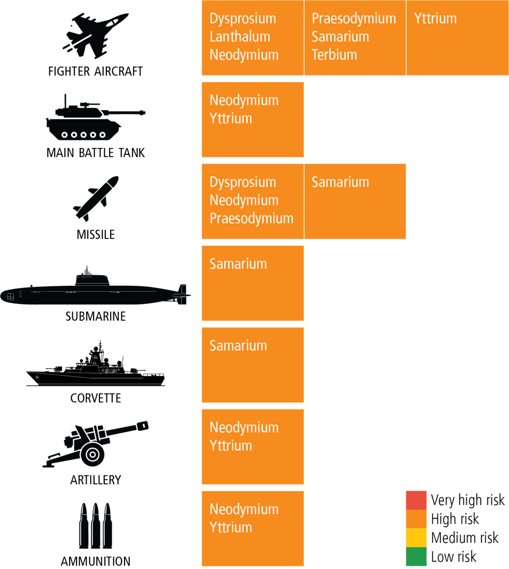
Source: Strategic Raw Materials for Defence, The Hague Centre for Strategic Studies, January 2023.
Important Disclosures
An investor should consider the investment objectives, risks, charges and expenses of each fund carefully before investing. To obtain a fund’s Prospectus, which contains this and other information, contact your financial professional, call 1.888.622.1813 or visit SprottETFs.com. Read the Prospectus carefully before investing.
Exchange Traded Funds (ETFs) are considered to have continuous liquidity because they allow for an individual to trade throughout the day, which may indicate higher transaction costs and result in higher taxes when fund shares are held in a taxable account.
Diversification does not protect against loss. The funds are non-diversified and can invest a greater portion of assets in securities of individual issuers, particularly those in the natural resources and/or precious metals industry, which may experience greater price volatility. Relative to other sectors, natural resources and precious metals investments have higher headline risk and are more sensitive to changes in economic data, political or regulatory events, and underlying commodity price fluctuations. Risks related to extraction, storage and liquidity should also be considered.
Gold and precious metals are referred to with terms of art like "store of value," "safe haven" and "safe asset." These terms should not be construed to guarantee any form of investment safety. While “safe” assets like gold, Treasuries, money market funds and cash generally do not carry a high risk of loss relative to other asset classes, any asset may lose value, which may involve the complete loss of invested principal.
Shares are not individually redeemable. Investors buy and sell shares of the funds on a secondary market. Only “authorized participants” may trade directly with the fund, typically in blocks of 10,000 shares.
The Sprott Rare Earths Ex-China ETF and the Sprott Active Metals & Miners ETF are new and have limited operating history.
Sprott Asset Management USA, Inc. is the Investment Adviser to the Sprott ETFs. ALPS Distributors, Inc. is the Distributor for the Sprott ETFs and is a registered broker-dealer and FINRA Member. ALPS Distributors, Inc. is not affiliated with Sprott Asset Management USA, Inc.