
Sprott Radio Podcast
The Future of Sound Money
In recent times, we have seen gold hit multiple all-time highs (53 of these milestones in 2025 alone) and substantial buying by non-western central banks. Meanwhile, bonds have not been providing the yields they used to, and the U.S. Secretary of the Treasury has acknowledged his appreciation for the yellow metal. What does this tell us about the future of gold in the global monetary system? Incrementum’s Ronnie Stoeferle joins Ed Coyne to share his analysis and thoughts on gold in 2026 and beyond.
Podcast Transcript
Ed Coyne: Hello, and welcome to Sprott Radio. I'm your host, Ed Coyne, Senior Managing Partner at Sprott. I'm pleased today to welcome back a longtime friend and guest on Sprott Radio, Ronnie Stoeferle. Ronnie, thank you for joining Sprott Radio once again.
Ronnie Stoeferle: Hey, Ed. How are you?
Ed Coyne: I'm doing well. More importantly, how are you doing? I've seen you on social media, you're running marathons, you're skiing, you're having a great life, gold's working. Let's get caught up on all that stuff. How have you been?
Ronnie Stoeferle: Busy. No, the marathon was last year. I try to do a marathon every couple of years. As an Austrian, skiing is the only sport we're good at. Finally, people are waking up to gold, and it's becoming a little bit more mainstream, and we're managing our funds very actively. It's been good.
Ed Coyne: Let's talk about that because you and I have been talking for several years now about this gradual uptrending in gold and silver, both on the physical side and the miners. Let's start with the last 16 months, because it seems like we woke a giant here with the performance and the way capital was flowing. Maybe unpack that for a bit and walk us through what we’ve been experiencing for the last year and a half.
Ronnie Stoeferle: I think that the foundation of this big secular bull market is obviously what we call the new gold playbook, which means that we should focus less on what's going on in the Western world and focus more on what's going on in Asia and the Arab world. Almost two-thirds of physical gold demand now comes from China, India and the Arab world. I think that's the foundation of this bull market.
Then, in 2022, amid sanctions against Russia, a new phase began, and since then, we have had three years in a row of central banks buying more than 1,000 tons of gold each year. Last year, I think it was 863 tons, so almost 1,000 tons again. That's a little bit less than one-third of annual gold production, so it is significant.
Then I think the third stage of this bull market was Western financial investors finally joining the gold party in 2024. Western capital is finally chasing Eastern buying, and I think that's significant.
Compared to two years ago, the sentiment is different. Back then, if you looked at the average price forecast from gold analysts at the big banks, they were all basically saying, “We're entering a bear market, we're going sideways.” Now, given recent performance, they seem a little more optimistic and confident, which is also a sign we're definitely not at the beginning of this bull market.
In soccer terms, we're somewhere in the second half of this game, but we can go to overtime, or we can go to penalty shooting. I would say a bull market, not a bubble. That's important, and I think there are many more catalysts to come. The question, Ed, is probably: is this a normal cycle, or are we at the beginning or in the middle of a remonetization of gold? I think that's the most important question.
Ed Coyne: That's one that I like to think about a lot. One of the people I was talking to recently said we're not even in a gold bull; we're in a fiat bear. The way the world is thinking about fiat currencies, they're restacking the deck. They're thinking about it differently, and gold is once again coming into that equation. What do you say to that, because that takes the whole bubble thing and puts it on the sidelines completely? If we're in a real reset where gold's being viewed as a true currency for a lot of these central banks, India, China, and so forth, what are your thoughts on that?
Ronnie Stoeferle: Your colleague, Paul Wong, wrote about the repricing. He said it's a matter of repricing trust in the new monetary order. I think that's a good framework to think about what's currently going on. From my point of view, it is really this loss of trust, loss of confidence that we're seeing, not only in finance, but also in politics, in the media, in science and so on. This is one very important driver for gold: it has built up such an enormous amount of trust capital over the last 5,000 years that, when trust is eroding in other markets, I think that's a huge advantage. It's not easy to put a price tag on that.
If we're coming back to that topic, the geopolitical architecture of the post-Bretton Woods1 era is changing. Europe has always relied on U.S. defense, Chinese cheap goods, and Russian energy. Somebody wrote that the U.S. is becoming a low-trust society. I'm not sure about that, but from my point of view, as someone based in Europe, long-term alliances and relationships are being put in question and replaced with new ones.
It seems that, now, if we want to really simplify it, the world is breaking into two monetary spheres. First of all, there's the East, which is increasingly backed by gold. The message will be, trust our reserves. Then there's the West, which is backed by U.S. treasuries, basically, in a digital wrapper, and it's trust our technology, trust our power.
The conflict we're seeing is that China wants gold higher to put pressure on the U.S., while the U.S. wants to suppress gold to maintain its hegemony. On the other hand, it's super interesting that, under the current U.S. administration, there are people who actually address the advantages and disadvantages of being the world's reserve currency, the Triffin dilemma, and so on.
Scott Bessent said he's a gold bug and that his biggest private possession is gold. Kevin Warsh was a partner at Stan Druckenmiller's family office. He also knows Scott Bessent quite well. Then there's Stephen Miran, who wrote this brilliant paper a couple of months ago. Gold is now playing on the center stage, and that's the big change that we've seen over the last couple of quarters.
If we view gold as being revalued from a monetary perspective, I think $5,000 is still way too low, given various monetary aggregates. We crunched the numbers on that in recent reports. If you say there's a certain percentage of gold backing U.S. or global debt, then we'll reach significantly higher price targets.
Ed Coyne: It's fascinating to think about gold in a way that I think a lot of investors don't see it this way. They focus so much on the price, but the reality is that gold's price doesn't really move. It's all the other assets around it are moving, and gold's just a reflective asset to those values. That's telling you that things are changing.
I know you have some comments on that, but before we get into that, I want to talk about the Western investor. It does seem, from an investment standpoint, that gold is now starting to get a bigger seat at the table. Are you seeing, in the work you're doing, that more investors are starting to think about gold from a diversification standpoint, in a way they maybe haven't in the past?
Ronnie Stoeferle: Yes. I've got a mentor, and he was also an advisor to us when we set up the company. He's very sophisticated, smart and just a great human being, and I also learned a lot from him. He always told me, "Scare your investors out of bonds." Now, I wrote a little note on the Post-it, and it has been sitting on my screen since then. He was way too early with that. I think he didn't really see that we would get negative rates, so it would be a guaranteed loss if you bought bonds. I think he didn't really see the various rounds of quantitative easing, but now it's really game time for the advice he gave.
We published a new gold playbook two years ago, and we said we had to rethink the 60-40 portfolio because it had only worked during the Great Moderation2. During that time, investors couldn't care less about inflation and inflation volatility. The old assumption was that bonds always hedge stocks, but in an inflationary world, that hedge actually fails. Bonds aren't a stabilizer anymore. They've become more of a deadweight.
I think it's also interesting that people say, "Well, this negative stock-bond correlation,” which is rather the exception, not the rule. We crunched the numbers, and over the last hundred years, stocks and bonds have moved together about 70% of the time. The 60-40 portfolio only worked because we lived through the Great Moderation, this long era of falling inflation rates. This era obviously is now over.
I think that even though central bankers and politicians want to tell us, "Well, inflation isn't the problem anymore." I think that if you go grocery shopping, go to restaurants, or even follow the official indicators, it is still a problem. I think a new wave of inflation is building now. What if the portfolio safety anchor is the bubble itself? I think that's a question that you have to ask institutional asset managers.
Here's the twist, Ed. In fixed income, U.S. $160 trillion is now allocated. I think the next big wave of gold demand will come from the fixed-income space. Even small reallocations from fixed income to gold, or hard assets in general, so not only gold, but also commodities, perhaps Bitcoin. I think that's really going to make a difference. I can tell you there are some closet gold bugs that I talk to that have very senior roles at big investment houses, and they get it. On the other hand, there are financial repression and legal reasons why they actually have to invest primarily in fixed income.
Ed Coyne: That's right.
Ronnie Stoeferle: We always have to have that in mind. I can tell you we're getting more inquiries from smaller and medium-sized institutional players, pension funds, and so on, that are reconsidering their traditional asset allocation.
Ed Coyne: Interestingly, you mentioned the pension funds. At Sprott, we've built an institutional team of almost half a dozen individuals. Because of that, we built a key account department. We're doing north of 100 RFPs (Requests for Proposals, i.e., indications of interest) a year now, whereas 10 years ago we were doing two or three a year. People aren't chasing this; they're just getting educated about it and being thoughtful about how they may allocate to it in the long term.
This could come off as selling our book on gold, but in many ways, the narrative is just really ramping up, and people are starting to think, "How do I allocate to this space over multiple market cycles and not just chase these returns?" We're seeing that as well from an RFP standpoint on both the institutional and the advisor brokerage sides. That interest is certainly picking up.
You're right: just a little bit out of fixed income into gold could have a significant impact not only on the validity of the allocation but also on its price appreciation. Let's talk then about the contrarian view of gold. Is that dying out then? By being a gold investor, you were the cool kid in the room or maybe the nerd in the room or the crazy kid in the room. Is that now becoming a more streamlined investment? Are we there yet?
Ronnie Stoeferle: I always come up with that analogy from cocktail parties. I don't really go to cocktail parties anymore.
Ed Coyne: You're not that old, Ronnie. Come on.
Ronnie Stoeferle: No, but a couple of years ago, if I had said, "I like gold, and we're invested in gold, and we are running funds in the gold space," people would have said, "Ah, gold, super boring. We want to hear about tech and whatever." Now, I think we're in this stage where people would say, "Ah, gold is interesting. I always said that you have to own some gold.”
I remember in the previous cycle there was a head of private banking, who approached me after a press conference. It must have been 2008 or 2007 when I published one of my first gold reports. She said that gold is useless. It doesn't pay any interest. It's debt capital. Then, one year later, she said, "Yes, we always said you have to own some gold."
You know how it works in our industry. I think we're now in this stage where it's becoming a little bit more mainstream, but we're not at the stage yet where people would say, "Well, Ronnie, what's your recommendation for a silver junior exploration mining company? Do you have some interesting private placements in the small-cap space?" We're not there yet, but it has changed.
On the other hand, I recently shared a chart on Twitter, based on Bank of America numbers. It's said that since 2020, we've had inflows into gold of $100 billion. Now, it sounds like a lot, but inflows into fixed income were $2.4 trillion, into equities $3 trillion, and into cash $5 trillion. I think compared to that within the institutional space, it's still fairly small.
There's still room to go, but the sentiment has changed. You mentioned previously, for example, a company that is slightly larger than Incrementum and also Sprott, probably Morgan Stanley, saying a 60/20/20 portfolio, 60% equities, 20% bonds, and 20% gold. That was crazy two or three years ago.
Ed Coyne: That's right. It wasn't that long ago. What's interesting is that I noticed this two years ago. It was the first time since I've been here that all the big research shops and all the big brokerage firms started talking the price higher, not lower. Invariably, no matter what happened in the market and for any reason why it happened in the market, every year's new outlook for gold for the coming year was always lower. That seems to be a fundamental shift as well. I think the old way was, if you invest in gold, you don't believe in equities.
Talk about gold now being a true productive, what I like to say, a low-cost, liquid way to hedge your portfolio. Can you talk about that a little bit and talk about those return patterns? I think people need to really understand that it is a productive asset. It does have a role in a portfolio, and it has certainly worked over the short-, mid- and even the long-term.
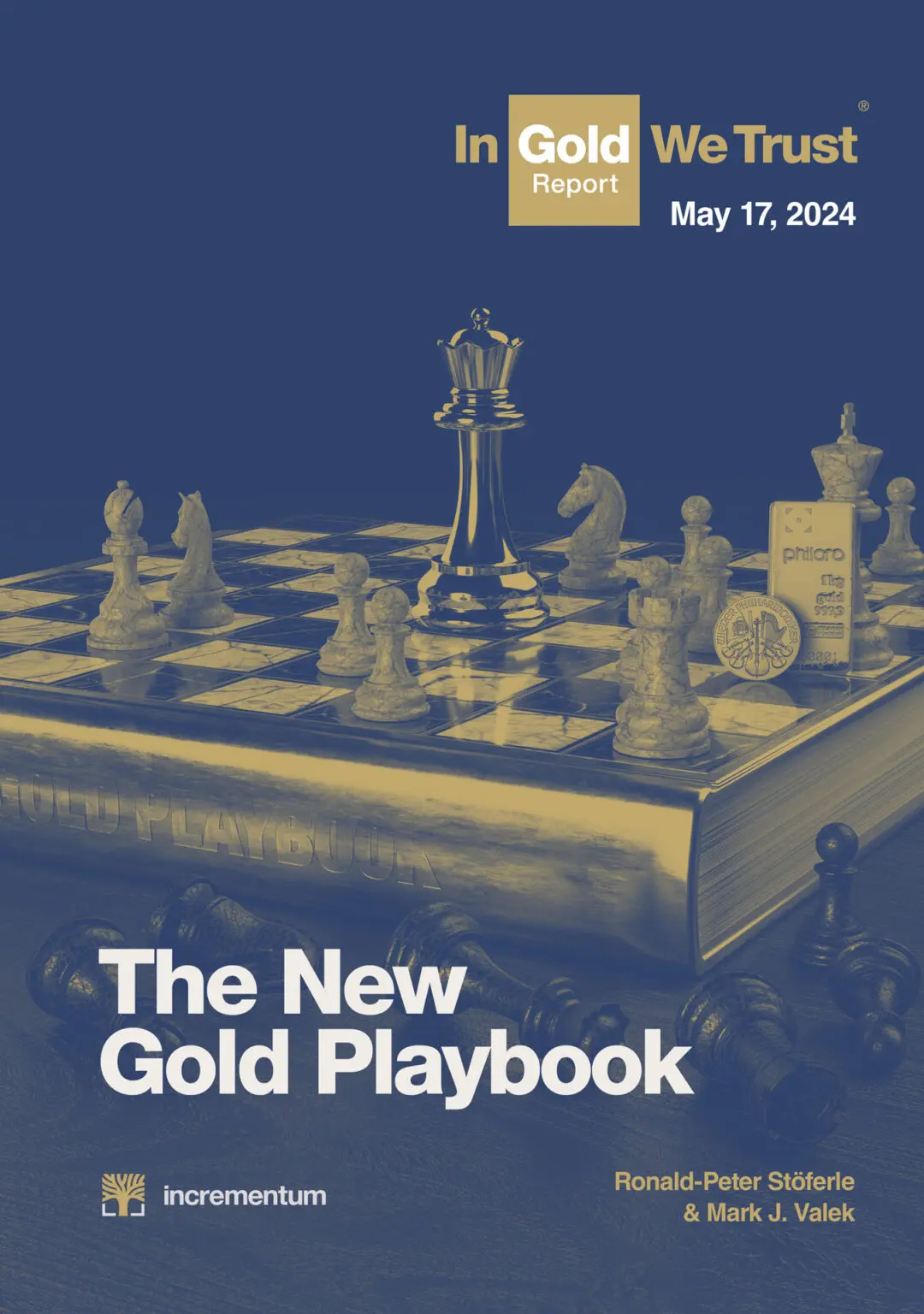
Ronnie Stoeferle: Yes, absolutely. The World Gold Council has released one of its recent reports, titled "Gold: Diversification That Works." I think that's summing it up perfectly. This year, we're publishing the 20th edition of our In Gold We Trust report. We crunched the numbers over the years because I think that gold is a perfect product. You cannot make it any better. Unfortunately, it has a very poor marketing department. I think it's quite easy to make a strong, positive case for gold, not as a religion, but as a portfolio diversifier.
When does gold work? It works in times of negative real interest rates, falling real interest rates, and a weak U.S. dollar. It works as an equity hedge in volatile, inflationary times and as a hedge against geopolitical developments, making it a valuable tool. I recently met with a very high-level politician, and we talked about everything, and then he asked me about gold. Then I said, "Well, actually, yes, I think that everybody should have some gold." He said, "Nah, but it doesn't pay any interest." I asked him, "What's your yield on owning treasuries? What's your yield if you're holding cash in your account?"
Have a look at the performance of gold in the last couple of years. 2024 gold was up 26%. In 2025, it was up 66%. Since January, gold has been up 14%. I think that argument is just ridiculous, but for some reason, people still come up with that. I think that has to do with mental accounting, probably, that mentally you think that a dividend or a coupon that you're collecting is something different than just the price performance.
From a diversification perspective, gold has performed tremendously over the last couple of years. I think that's really what we, and I think also you at Sprott, want to emphasize. It's diversification that works. Let's not treat it as a religion or the solution to all our problems, but just as something that, in this environment, has to be, basically, in every diversified portfolio.
Ed Coyne: This next question is going to be a little controversial, but I want to get your thoughts. You say you're getting ready to produce your 20th year of In Gold We Trust. What would cause you to walk away from the gold trade or turn your back on it? What would need to happen for you to do that?
Ronnie Stoeferle: There will be no point in time when I'd say you should have zero allocation to gold, but reducing your allocation and realizing some profits, definitely. To answer your question, probably a return to sound money, probably gold, would change my view then. Obviously, if we come up with a solution to the whole debt problem we're facing worldwide, it seems there's nothing really around the corner yet.
It's going to be interesting because we'll have a conversation with Dr. Judy Shelton for the upcoming In Gold We Trust report. She's proposing gold-backed 50-year or even century bonds for the U.S., and she'll announce them on the U.S.'s 250th birthday, the 4th of July. That would be interesting if it were possible without blowing up the system, just starting with the revaluation of gold reserves, some sort of gold-backed bonds, and then a modern debt jubilee. That's something that I wouldn't rule out anymore.
I've got dozens of books about monetary history. I think that the last couple of years were the exception to the rule. I think, at some point, we will go back to some sort of gold backing again. It's always been like that. I hope that doesn't sound too gloomy or sensationalist, but it's just the facts. It's just history.
I think if you look at gold demand from emerging markets, especially from central banks, it's obvious they're preparing for something. A friend of mine, who's well-connected, once said, "If you want to play poker with the big guys, you have to bring lots of chips to the table." Those chips are made of gold, actually. I would say, over the next 5 to 10 years, there will be a fundamental change in our monetary system. I think that gold will play, as always, a very important role in that.
Ed Coyne: We've talked a lot about gold from a diversification standpoint. Let's talk about it from an opportunity standpoint, then shift gears to the miners. The miners, for the longest time, even though gold was doing well, were just trying to play catch-up, but could never really get moving. More recently, that's starting to change. I think I had you quoted as saying, "I don't like the miners, I love the miners." Maybe we're a little early, but it's really starting to move. How do you feel about the miners today? What's going on?
Ronnie Stoeferle: That was basically the thesis of the 2025 In Gold We Trust report called The Big Long. We said, "Okay, gold is in a secular bull market, but now it's time for silver, mining stocks, and commodities, finally breaking out and showing some outperformance of gold." This actually happened. Silver is outperforming gold now, finally. We're seeing miners finally outperforming gold.
It seems that management teams and, even more so, analysts still don't believe that current price levels are sustainable. Most of them are still showing $2,500 in their long-term and internal forecasts. I think the industry is still scratching its head and is kind of bearish. To emphasize this level of bearishness, we had net outflows from the VanEck Gold Miners ETF (GDX) and the VanEck Junior Gold Miners ETF (GDXJ) in 2024 and 2025.
You have to ask yourself: who's selling into strength, and who's left to buy when the flows turn? From my point of view, the miners are under-owned, misunderstood and disbelieved, and that's not how a big secular bull market actually dies. They die in euphoria, not in redemption. Therefore, I would say it's still early, and for our funds, we're still finding many opportunities.
I can tell you that the risk appetite is now finally there. For good companies, they can raise significant amounts of capital, $50 or $100 million, for their financings within a couple of minutes, actually. Definitely, there's more risk appetite. If you look at the balance sheets of the large gold producers and the royalty and streaming space, there's just an enormous amount of value on their balance sheets.
I think we haven't really seen the big outperformance by the developers and the juniors yet. We haven't seen any crazy (mergers and acquisitions) M&A yet. It's going to happen at some point. I think if gold is in the second half of this game, the miners are still at the end of the first half. We've seen that, for example, in the 1970s big bull market, while gold peaked in January 1980, I think the miners only peaked 1.5 years after.
Ed Coyne: I guess the margins keep expanding. What is the all-in sustaining cost to pull an ounce out of the ground? Granted, certain parts of the world are more challenging than others and so forth, but what's a general ballpark number you're using these days?
Ronnie Stoeferle: I would use between $1,600 and $1,800. Obviously, at these prices, you can do low grading, and there are lots of brownfield developments now coming on stream and so on. I think that the all-in sustaining costs will rise. That's just a function of the price. Still, the margins are just incredible. At some point this year, I think the large producers will realize what to do with all this cash flow and just redistribute it to shareholders.
As far as I know, mining investors don't buy the miners because of their dividend yields. I think if you've got a 3% or 5% dividend yield in a mining stock compared to its volatility, it's not really a factor. There will be more stock buybacks, but I think it's going to be a huge, huge M&A cycle.
Ed Coyne: You mentioned silver a few times in passing. Let's talk about that because, obviously, silver last year had an incredible run. Then a few Fridays ago, it had a bit of a sell-off or maybe a profit-taking or maybe just a, "Hey, wow, this went up way too fast. I need to pull some back." Talk about silver. Is silver starting to step out of gold's shadow and really become its own personality, both from a monetary standpoint and from an industrial standpoint? Can you talk a bit about what's happening in silver today?
Ronnie Stoeferle: I remember I was at (the Vancouver Resource Investment Conference) VRIC that week when gold made new all-time highs and silver went to $117. Then there was just this brutal day on Friday. I was skiing with a friend and my wife. Just on the lift, I had a look at the chart. I couldn't believe what was going on. The good thing is we were well hedged in our funds, and it didn't really affect us that badly.
Corrections entail both price and time. I believe we're in the middle of a corrective move in gold and silver. We can talk about the reasons for that correction, whether it was too much speculation or the margin shocks, and whether it was manipulation or whatever. I think what really made me optimistic was that gold and silver were hit hard, but most miners and even some explorers held up really well. I think that was quite encouraging.
I would say silver will establish a bottom somewhere around $70 or $80. That's going to be the new foundation for the next leg up, probably. I was perhaps lucky, but I said in interviews previously that the market is always fascinated by the round numbers. That was $5,000 in gold and $100 in silver. That was also, perhaps, the psychological reason for many people; I know some silver investors who bought in the previous bull market.
I remember my wife always told me, "What to do with your silver that is lying around?" I said, "Yes, well, it's going to have its day." Then she said, "Yes, what are we doing with our silver?" I said, "Okay, previously, it was your silver; now it's our silver." I think, given the supply-demand setup, we know the supply side is very inelastic. We know that on the demand side, there's just structural demand driven by technology. We're seeing lots of drivers on that front.
Then what's really the icing on the cake is investor demand. We know that the silver market is significantly smaller than the gold market and less liquid. I think silver is now really transitioning from a forgotten monetary commodity to a leveraged play on gold, and then to a strategic asset for national security. I think that's also very important.
We know that silver has characteristics that are just very special. Now the U.S. has listed silver as a critical mineral. We know that the solar demand has grown from 11% in 2014 to 30% in 2025. The forecast I've read suggests that solar alone could consume 85% of current reserves by 2050. Of course, there will be technological developments, but I think that's a major driver of demand.
Then I would say that many people still see silver as cheap, both relative to other assets and on an absolute basis. Therefore, I would say that if it's going to continue to grow, if people realize, "Well, actually, gold is good, you should own some gold, but if you want to have a little bit more oomph, then you need silver." I think that's happening, but it's going to take more time, and we're not at a gold-silver ratio3 above 100 anymore. Back then, it was easy. We've seen more mean reversion now, but compared with previous gold bull markets, the gold-silver ratio has settled at significantly lower levels, between 10 and 20. There's still a way to go.
Ed Coyne: Is the gold-silver ratio still relevant in your view, given that silver is really a consumer metal as far as it's being consumed in things like solar panels, where gold is still predominantly being stored as a monetary metal? Assuming you agree with that narrative, does the gold-to-silver ratio hold up anymore? Does it really matter if silver is becoming its own personality?
Ronnie Stoeferle: Yes, that's a great question, Ed. I wouldn't trade or invest based solely on the gold-silver ratio, but I think it's a sort of compass. We crunch numbers on that. A falling gold-silver ratio, so silver outperforming gold, is also a good confirmation indicator for the strength of a gold bull market. In a strong gold bull market, you want to see silver outperforming gold. Therefore, for me, it's still relevant, but we can challenge that view. I'll be happy to crunch the numbers on that and discuss it, perhaps in our upcoming In Gold We Trust report.
Ed Coyne: Is there anything else out there that's caught your eye, other metals? I know you've been a big supporter of cryptocurrencies in general, specifically, I think Bitcoin, but other metals out there that maybe have caught your eye or you have some interest in, given where we are in the cycle right now?
Ronnie Stoeferle: The big change, and I realized that attending the Precious Metals Summit in Beaver Creek last year, all the companies that I talked to, and we're seeing 150, 160 management teams of mining companies every year. Most, if not all, U.S.-based companies said, "Well, actually, we are being actively approached by the U.S. government, by bankers, by diplomats, and they want to do off-take agreements, finance us, build long-term relationships when it comes to commodities."
I think it's the fact that politicians have now finally woken up, even in Europe, realizing that commodities aren't something bad, something dirty, but rather something that is the foundation of our industries, and our societies, and that you want to have or you need to have reliable access to commodities. I think that's really the big change.
I like silver and gold as monetary metals. In the commodity space, I really like copper and nickel. I like some other special metals like gallium, for example. I also think there's tremendous value in the oil and uranium space, where we're running one fund. Why is there this change of sentiment when it comes to commodities? I think it's primarily because ESG has been the big trend in investing over the last couple of years. You could say it's also a bull-market phenomenon if you can afford ESG-style investing.
This has changed over the last couple of quarters. Institutional investors realize that mining companies, especially listed mining companies, do a pretty good job of taking care of the environment and supporting social aspects in communities and so on.
That's really the big change: a little bit more capital from institutional investors. If you have a look at the Bloomberg commodity chart, it looks like a new bull market, but if you do it ex-precious metals, so if you take out gold and silver, then it's still very much at the beginning of a new bull market. This is really one of our biggest convictions.
Ed Coyne: Do we dare say the word “super cycle,” or is it too soon for that?
Ronnie Stoeferle: I don't like the term “super cycle,” but I would say “bull market,” yes.
Ed Coyne: Bull market. Fair enough. Super cycle just sounds so cool though. I love saying it. Before we sign off, are there any last points you were hoping to make that I didn't bring up that you think are worth the listeners' hearing from you on?
Ronnie Stoeferle: One of the biggest risks in a big secular bull market is getting out too early. Our mutual friend, Rick Rule, always says you shouldn't waste this bull market, but it also means you shouldn't get too greedy and know your risk and volatility that you can handle.
I think, as we're seeing now, back to October, this big sell-off in gold was below $4,000. Then it bounced back so quickly because there's just so much capital waiting on the sidelines. Now, again, everything below $5,000 was being bought big time. This is telling me there is still an enormous amount of capital eager to enter this trade. Read high-quality research, like the stuff that you at Sprott put out and the stuff that we put out in In Gold We Trust. I think we'll have a lot of fun going forward in this bull market.
Ed Coyne: I love it. Well, Ronnie, it's always a treat to talk to you and get your thoughts. I'm looking forward to May 20. That's always one of my favorite pieces of research that comes out every year. I'm one of maybe the last few people who still look at it in physical form, dog-ear it and highlight stuff. This will be an exciting year to celebrate 20 years. Congratulations on that. Once again, my friend, it's great to catch up with you.
Ronnie Stoeferle: Thank you very much, Ed. I think my family also looks forward to May 20 because I'm in the tunnel for three months, working on nothing but In Gold We Trust. It's rewarding. After 20 years, I still enjoy thinking and writing about gold. It's just so fascinating because there's so much going on: gold doesn't change, but the world around it is changing in extreme ways. Thinking about those topics will always fascinate me. Thanks very much for having me. Thanks for the support. Yes, we'll probably talk after the next gold report is released.
Ed Coyne: For sure. Well said, my man. Once again, I'm your host, Ed Coyne, and thank you all for listening to Sprott Radio.
1 The Bretton Woods system was the post–World War II international monetary framework that fixed exchange rates to the U.S. dollar and effectively ended in 1971 when the U.S. suspended gold convertibility.
2 The Great Moderation refers to the period from roughly the mid‑1980s to the Global Financial Crisis (2007–2009) characterized by low and stable inflation, reduced volatility in economic growth, and fewer severe recessions, widely attributed to improved monetary policy, globalization, and financial innovation.
3 The gold-to-silver ratio measures how many ounces of silver are required to purchase one ounce of gold, calculated by dividing the price of gold by the price of silver. It is commonly used as a relative valuation indicator to assess whether gold is expensive or cheap compared with silver.


Important Disclosure
This podcast is provided for information purposes only from sources believed to be reliable. However, Sprott does not warrant its completeness or accuracy. Any opinions and estimates constitute our judgment as of the date of this material and are subject to change without notice. Past performance is not indicative of future results. This communication is not intended as an offer or solicitation for the purchase or sale of any financial instrument.
Relative to other sectors, precious metals and natural resources investments have higher headline risk and are more sensitive to changes in economic data, political or regulatory events, and underlying commodity price fluctuations. Risks related to extraction, storage and liquidity should also be considered.
Gold and precious metals are referred to with terms of art like store of value, safe haven and safe asset. These terms should not be construed to guarantee any form of investment safety. While “safe” assets like gold, Treasuries, money market funds and cash generally do not carry a high risk of loss relative to other asset classes, any asset may lose value, which may involve the complete loss of invested principal. Furthermore, no asset class provides investment and/or wealth “protection”.
Any opinions and recommendations herein do not take into account individual client circumstances, objectives, or needs and are not intended as recommendations of particular securities, financial instruments, or strategies. You must make your own independent decisions regarding any securities, financial instruments or strategies mentioned or related to the information herein.
While Sprott believes the use of any forward-looking language (e.g, expect, anticipate, continue, estimate, may, will, project, should, believe, plans, intends, and similar expressions) to be reasonable in the context above, the language should not be construed to guarantee future results, performance, or investment outcomes.
This communication may not be redistributed or retransmitted, in whole or in part, or in any form or manner, without the express written consent of Sprott. Any unauthorized use or disclosure is prohibited. Receipt and review of this information constitute your agreement not to redistribute or retransmit the contents and information contained in this communication without first obtaining express permission from an authorized officer of Sprott.
©Copyright 2025 Sprott All rights reserved