
Sprott Radio Podcast
Back to The Monetary Future - PART 1
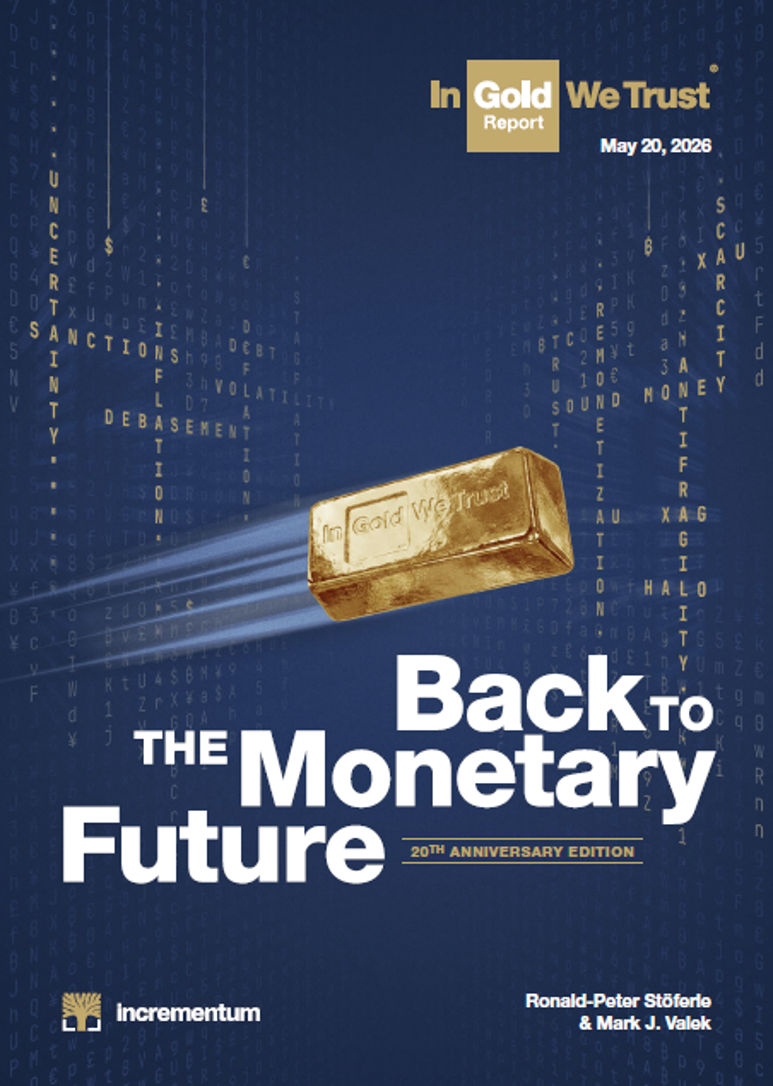
Ed Coyne welcomes back Ronnie Stöferle to discuss the 20th anniversary edition of the In Gold We Trust report, Back to the Monetary Future. Ronnie reflects on two decades of gold’s evolution as a monetary asset, central bank buying and the new thinking on gold’s place in modern portfolios. The conversation also explores why gold’s simplicity, liquidity and lack of counterparty risk may matter more than ever in an increasingly uncertain financial system.
Podcast Transcript
Ed Coyne: Hello, and welcome to Sprott Radio. I'm your host, Ed Coyne, Senior Managing Partner at Sprott. I'm pleased today to welcome back one of our original annual guests, Ronnie Stöferle, Managing Partner at Incrementum AG. Ronnie, it's always good to see you, and thank you for coming back.
Ronnie Stöferle: Thanks for having me, Ed. Pleasure.
Ed Coyne: Ronnie, summertime, of course, is warm weather, beaches, all that. It's also the In Gold We Trust annual report. Something special happened this year that hadn't happened before—an anniversary, so to speak. What makes this year so special?
Ronnie Stöferle: Every year we try to write less, and we just fail. We're not writing for the sake of writing a long report; there's just so much going on. If there's just one piece about gold and precious metals that you have to read each year, it should be our In Gold We Trust report. Obviously, as the 20th anniversary edition, we thought this had to be a big one.
We completely renewed the layout. We've got great new writers. For example, Izabella Kaminska wrote a chapter about Tether. We've got some thought-provoking chapters. If we sum it up, it's about zooming out and analyzing how the monetary and financial system will develop over the next 20 years. For us, it was a big thinking process with lots of discussion and reading.
It's worth zooming out, especially these days, when there's so much daily noise, and thinking and writing about the long term. Our conclusion is that if you want to understand the future of money, you have to understand the past. This is why we are referring to Back to the Future, this brilliant movie that we all know. When I realized that the younger team members had never seen it, they said, "Back to the Future, Marty McFly. Who's that?" I gave them some homework to watch the movie.
Ed Coyne: Perfect. The title is great: Back to the Monetary Future. By the way, congrats on 20 years. That's quite an accomplishment. I can only imagine what life was like when you started this venture 20 years ago and how it is now, for Incrementum, for you and for the gold narrative. What's changed in those last 20 years, as you've continued to do this report every year? 20 years of doing this has got to be some stuff you've seen change over the years as relates to gold and how people receive it.
Ronnie Stöferle: So much has changed. When I published the very first In Gold We Trust report, I was still a young analyst sitting in a bank with a full head of hair. Back then, George W. Bush was president. Italy was the soccer world champion. Netflix did mail DVDs. We didn't have an iPhone. Gold was trading around $650. The U.S. national debt was $9 trillion, which I think was 60% of GDP.
This was before the subprime crisis. Nobody knew what quantitative easing would be, that interest rates could go to zero or even below zero. Nobody knew about the Austrian school of economics. I think most people thought the Austrian school was some kind of obscure Alpine sect, religion or whatever. There was no Bitcoin back then. 20 years is a long time. I think that there are still so many things that people keep saying now, the same things that they said 20 years ago, like, "Gold doesn't pay any interest. It's a useless metal. It's a pet rock. It's not a good diversifier," stuff like that.
I keep hearing that, even though gold over that time frame was by far one of the best assets and strongest currencies. It bugs me, and it's telling me, "Well, you still have a big job to do to inform people and also educate people about sound money and what gold does to your portfolio." On the other hand, I also regard it as an opportunity because it tells me we are far from a crowded trade.
Ed Coyne: I went back and read some of the old reports as well, getting ready for this.
Ronnie Stöferle: You did your homework.
Ed Coyne: All this morning.
Ronnie Stöferle: Yes, appreciate it.
Ed Coyne: One of the things that I found was a recurring theme is your view or vision on gold, that gold basically has always been gold. It doesn't really change. It's the economy, the world, and the market around it that keep changing. Can we unpack that concept a little more? Maybe our newer listeners don't fully appreciate that. Let's talk about that a little bit. How gold just sits there, does its thing, to your point, doesn't pay a dividend, doesn't have income, doesn't have earnings, but yet it continues to do its thing over and over again, and the world around it keeps evolving and changing. Let's talk about that a bit if we could.
Ronnie Stöferle: Gold itself is a perfect product. You cannot improve it. It's been a trial-and-error process over the last thousand years, and the market decided that gold is the perfect money. Gold is something special in every religion, and that's not a coincidence. You can go to a temple, church, or mosque and see gold. You can go to every continent; you will see that people care about gold. They decorate themselves with gold. They save in gold.
It was a decision made over thousands of years by billions of people. One interesting thought, Ed, is that there's a gentleman named Tony Deden, who's a good friend and a mentor to me. His son-in-law, Michael Weeks, wrote something very simple, but it's brilliant. He said, "What makes gold compelling is the risks that we don't take by owning it. It's basically turning the usual valuation logic on its head.
He says that, "The value of gold lies not in what it promises, but in what it spares its owners." Nassim Taleb called it this via negativa approach. Gold doesn't carry any duration, credit or liquidity risk. There are no balance sheets that could implode. There are no cash flows that could dry up. There is no stupid management taking ridiculous amounts of salaries or options. You don't need any trust or goodwill of a counterparty.
It only requires a secure storage location. In a world where inflation is persistent and the fiat monetary experiment is probably entering its later stage or cycle, I think it's precisely this absence of risk that makes gold so special and is its primary competitive advantage. Simplicity is the ultimate sophistication, as I think Leonardo da Vinci once said.
Ed Coyne: You talk about this Pax America or American piece that we're coming to the end of that; maybe the U.S. dollar isn't as supreme as it once was. What would that mean for gold in your view, based on the comments you just said? Let's start with that, and then I want to get into the whole bond narrative as well.
Ronnie Stöferle: I think we're not necessarily in the de-dollarization camp. I think there are very strong dollarization drivers, but also strong de-dollarization drivers. I always said that before de-dollarization, there would probably be de-euroization. This is exactly what we're seeing at the moment because no emerging-market central bank wants to buy euros, Japanese yen or Chinese yuan as a reserve asset.
Gold overtook the euro last year as the primary reserve currency. Also, due to the price appreciation, it overtook the U.S. dollar a couple of months ago. It seems that, since 2022, the invasion of Russia in Ukraine and then following the sanctions against Russia, the world and especially emerging markets, desperately need a neutral monetary reserve asset. A neutral monetary reserve asset that cannot be inflated at will, that is highly liquid.
We had a couple of days this quarter when more than $500 billion in gold was traded per day. Gold is extremely liquid, with a very tight bid-to-ask spread. It's accepted all over the world. I always compare it to this: if you go on vacation and you lose your credit card or it stops working, you need a plan B. I think gold is the plan B that emerging-market central banks still have.
It's also a sign that they want to be treated well. I think not like the younger brother, where the big brother doesn't take him seriously. I think when it comes to technology, the military and other areas, we've been underestimating China, especially over the last couple of years. People tend to forget China's enormous growth over the last 35 years. The GDP per capita in 1990 was $318. Last year it was $14,000.
Those are average numbers across 1.4 billion people. An enormous amount of wealth was being produced. Productivity was achieved. I think gold is just one sign of emerging markets seeking to diversify away from the U.S. dollar and say, "We want to play poker with the big boys, and you have to bring golden chips to the table." That's basically my view in a nutshell.
There are so many different aspects of this de-dollarization versus dollarization. We've got stablecoins. Just follow the GENIUS Act and its impact on the demand for U.S. Treasuries. All those bilateral agreements, in which it seems the U.S. has shifted its focus away from Southeast Asia toward Latin America and Central America. Europe is complicated, and I’m not so sure it’s going to develop. It's not a yes-or-no de-dollarization. Is it happening? Yes, but on the other hand, they are very strong dollarization factors. That's what we try to summarize in the report.
Ed Coyne: As more hard assets look to get tokenized, whether it's gold, oil, you name it, does that change the definition of what money is? Does that bring gold into the limelight then, as things start to get tokenized? You think about what Tether's doing, these stablecoins out there and so forth. What is the landscape of that? I know you've been a big follower and a big believer in Bitcoin in general as part of the overall portfolio, but what does that mean for gold going forward as we go down this path?
Ronnie Stöferle: For the tokenization of gold, let's start with that pocket of the market. There are many projects we are following. I think tokenization changes how gold moves, but it doesn't change what gold actually is. At the moment, three layers are emerging: retail access, institutional plumbing and speculation.
I think that each of those layers adds some convenience, but it also reintroduces the counterparty risk that gold, as we talked about before, eliminates. It's a bit of a strange development, and it's a different audience from the one those token projects deal with. It's not going to make a huge difference. Tether was definitely one of the most important drivers because, at the margin, they've been a very powerful buyer of gold recently.
We've got an exclusive interview with Juan Sartori, the head of special projects in the report, and he's talking about the entire ecosystem Tether wants to create. It's really fascinating, and they also improve their perception from an institutional perspective. They finally have audits now; I think BDO is doing them. I think lots of the questions that were asked over the last couple of years are now being answered.
He basically explains that Tether has never been a big business model that they would collect any interest from holding their treasuries, but then interest rates went up, and they said, "Well, we are getting 4% or 5% from holding those U.S. treasuries. What to do with all that cash that the U.S. government is paying us?" They said, "Well, let's invest in hard assets. Let's invest in physical gold, in farmland and in Bitcoin."
Then they said, "Well, actually, we want to store our physical gold outside of the banking system in Swiss vaults somewhere in the Swiss Alps." Now with the GENIUS Act, it's obviously a big push for stablecoins. I would expect much more volume to be purchased not only by Tether but also by other stablecoins. I think it's ironic that they basically collect interest rates and then invest right away on the other side of Bitcoin.
Ed Coyne: It sounds like crypto and gold are going to continue to coexist. There used to be, in the early days of crypto, a belief that it would replace gold. Then, as crypto showed some volatility, no, gold's going to continue to be the leader. That narrative seems to be maybe drying up, and they're both going to work in different ways for different reasons. Do you subscribe to that? What's your view on that?
Ronnie Stöferle: If we talk about the tokenization of gold, there are good products for people who aren't traditional gold buyers. For crypto in general, we've always said that 99.9% of projects are rubbish. That's why in our funds we only combine gold and Bitcoin, no other cryptocurrencies. Bitcoin is obviously having a hard time at the moment.
Bitcoin is a very sensitive gauge of liquidity momentum. Obviously, Bitcoin topped way earlier than gold. I think the fact that Bitcoin is holding up quite okay-ish might be a sign that gold is also getting closer to a bottom. Bitcoin now has a higher stock-to-flow ratio than gold. I've been following the scene for many years, but I'm still a gold guy.
Ed Coyne: As do I. I want to go back to what we mentioned a moment ago about bonds. You talked about gold and what it does and why people get upset about it because it doesn't give you income, and so forth. Yet more and more people, yourself included, the JP Morgans of the world out there, they talk about this whole 60/40 model being broken and how gold is stepping in and replacing part of that bond allocation. What's your view on that today? How has that evolved over the last couple of years? Do you still think gold could step in and replace at least part of your bond allocation, if not all of it, going forward?
Ronnie Stöferle: I've got a little Post-it note on my screen that says, "Scare your investors out of bonds." This is advice that another mentor of mine, when we set up Incrementum, told me: scare your investors out of bonds. He was way too early. I think now, with no negative correlation between stocks and equities anymore, in a time when the Federal Reserve, I think, has failed to reach the 2% inflation target for 64 or 65 months in a row.
Now with Kevin Warsh, everybody thinks it's going to be different, but just have a look at the trimmed PCE (Trimmed Mean Personal Consumption Expenditures inflation), his favorite inflation indicator. I don't think that inflation will really be out of fashion in our industry over the next couple of years. We said back in 2020 that it would be an inflationary decade. We were extremely contrarian back then. Nobody was talking about inflation. If we say that global wealth in the asset management industry, by far the biggest part of this pie is fixed income. That's, at the moment, I think, $147 trillion.
I think we only need small crumbs from that big part of the pie going toward hard assets, be it commodities, gold, mining equities, Bitcoin, whatever. I think this is where the potential for hard assets lies. We crunched the numbers, we analyzed what gold does to your portfolio. Gold isn't the solution to all our problems. It's not the perfect answer to all the issues and the problems that we have in the world, but gold does its job as a portfolio diversifier really well.
I think we talked about that previously, Ed, but I think it's important to make the case for gold and the positive case for gold as a portfolio diversifier, especially outside of our little gold world. I think Sprott obviously does a tremendous job in talking to institutional players, to pension funds, to insurance companies. I think this is where the real potential comes from because, as we know, the overall gold allocation is 2.7%. There was a recent UBS family office study, and on average, they've got a 3% allocation to gold. 3%, let's face it, is pocket change. It doesn't really make much of a difference to your overall portfolio, especially if it's fixed-income-heavy. I think this new 60/40 portfolio that we described in 2024 is working extremely well in real time with a much smaller drawdown and a spectacular Sharpe ratio compared to the traditional 60/40 portfolio. There are now companies like Morgan Stanley, and Mike Wilson is talking about the 60/20/20 portfolio: 60% equities, 20% bonds, and 20% gold. That's Morgan Stanley, not little Incrementum.
I thought that was a big milestone. It's not just Mike Wilson; there's also Jeff Gundlach. We've got Stan Druckenmiller. We've got so many great investors who studied history, including monetary history and know what inflation does to your portfolio. That makes me very confident about gold. As you know, our take has been that gold isn't a contrarian investment anymore like it was a couple of years ago. I think we're taking a breather in this market. There are a couple of drivers suggesting that January wasn't the peak of the secular bull market.
Usually, you would see the gold-silver ratio trading significantly lower and crazy M&A activities in the mining space. You would see much higher allocations, much higher price targets, and broader participation from big names on Wall Street. We haven't really seen that yet, so I'm confident it's just a big correction within a secular bull market; we haven't reached a mania stage yet.
Ed Coyne: I think it's interesting that when you started doing the In Gold We Trust report, gold was at $650 an ounce. Today it's over $4,000, and it seems to be bouncing around $4,000. That's an incredible return that you've had over a 20-year period. You're hard-pressed to find a lot of other assets that did quite as well as that. To your point, it still doesn't feel like we're in a bull market. It's just getting going on our side as well.
You also mentioned, which I thought was spot on, that the big investment houses are not putting these big numbers up there. What I have noticed is they're no longer calling for lower prices. For the first seven to eight years I was at Sprott, their forward-looking price was always lower than the current price. That seems to have stopped. Maybe that's the beginning of something. What's your take on that? I think following what the big institutions are doing and how they're talking about it, and the whole 60/20/20 narrative coming out. Is that the tip of the spear, with things to come still looking very positive?
Ronnie Stöferle: John Hathaway always showed this Bloomberg commodity price forecast chart at his presentations, with the forecast by the large institutions. This is exactly what you said. They've always been bearish, but now that this started last year, it seems it's not so much of a career risk to have a positive view of gold. They're always trend following. The fact that some bigger banks had optimistic forecasts is also a sign that we're not at the end of the trend. It can go much longer. In Dow theory terms, it's the so-called public participation phase.
Over the last couple of weeks, all those big banks said, "We have to lower our forecasts. Today, there was the Wall Street Journal with a very negative piece on gold, and the cyclical story that we're seeing now, stronger U.S. dollar, rising yields, and more hawkish Federal Reserve, are all headwinds for gold. Of course, it's easy to justify lower prices. Then there's a structural story: fiscal deficits continue to widen.
We've got sovereign debt burdens at historically high levels. Central banks continue to diversify their reserves into gold. We've got China buying record amounts of gold. As the always brilliant Jim Grant said, the only permanent truth in finance is that people will get bullish at the top and bearish at the bottom. The last couple of weeks, we've already seen quite a lot of bearishness in gold. That makes me, from a contrarian perspective, optimistic again.
Ed Coyne: I know UBS is a European bank, but they just published an interesting article calling for a 30% rise in gold to $5,300 by the end of the year. It's not everybody yet, but it's interesting to see that. I think that's a good point. You mentioned central banks. That's been a common theme for In Gold We Trust as well, and the strength and buying of central banks. In particular, as you mentioned, China and Poland were, I think, the two biggest buyers in the second quarter. What's your take on that? Do you see them buying opportunistically because prices have come down, or do you see them as evergreen buyers as they print more money and take on more debt?
Ronnie Stöferle: The Asian mentality is definitely more opportunistic and contrarian. China has been buying hand over fist the last couple of weeks. I think the $4,000 number is also a big psychological threshold, and below $4,000, there's an enormous amount of demand. I think lots of that demand is coming from China. Let's not forget we had three years in a row with central banks buying more than a thousand tons; last year, only 874 or 875 tons.
In absolute terms, that was due to the rising gold price, including an absolute all-time high. Many people said, "The first quarter of the year will be really weak." Actually, we saw more than 250 tons of gold. Also, the second quarter of this year is probably going to be strong. It seems that, as confirmed by the World Gold Council's central bank gold survey, there's a record number of central banks saying they will continue to buy physical gold as part of their diversification and buying programs.
I think this is one of the six vectors of the gold remonetization, and it's probably one of my favorite chapters in this year's report. There will be a time when there will be a lot of pressure on Western central banks, especially on what we call the "gold light" countries, such as Canada, England and perhaps Japan.
There are a couple of countries that hold very little or no central bank gold. Perhaps there will be a point in time when they start buying gold again. That would probably go hand in hand with quite some turmoil in their bond markets. We've already seen that in the UK previously. I think that central bank demand will stay one of the most important pillars of the demand side. What we really need, and we haven't really seen that over the last couple of weeks, is Western financial investors buying gold. I think that's typically gold ETFs, and there were like big outflows.
Also, here, there's a big divergence between the behavior in the Western world, lots of selling, very procyclical, while Chinese gold ETFs had big inflows in the last couple of months. That's also a narrative kind of thing. Gold, at the moment, doesn't really have a narrative, a story. We had this debasement trade, and then Tether bought large amounts of gold last year. Now I think we don't really have the story. Everybody buys into the Federal Reserve being super hawkish now and believes that Kevin Warsh is the new Paul Volcker. I don't really buy into that, but for the time being, that's the story out in the market.
Ed Coyne: I want to talk about the risk on the equity side of things and talk about the miners for a minute. We spent a lot of time talking about the physical market. There's starting to be a little bit of interest being piqued from investors in the miners, but it's still playing catch-up with the physical market. Any comment on that, on what's going on? You've seen this slow maturation of investor interest in miners, but it really hasn't caught on the way I would have thought it would by now, given the appreciation we've seen in the physical market.
Ronnie Stöferle: We are running one active gold strategy, and at the moment, we've got 65%-68% cash to allocate. Buffett said that in the 1970s, he felt like a little kid in a candy store.
I'm feeling the same way because I think that we're seeing really attractive valuations. Obviously, the algorithms say gold is falling, and oil prices are rising. Just sell your mining equities. If we look at the facts, gold was up almost 60% last year. The sector's free cash flow was up 160%. That's real leverage. All three major gold producers are now net cash; they're buying back stock.
They don't know what to do with all the free cash flow they're generating. The first quarter of this year was the best quarter that the mining sector has ever had. Of course, we're seeing that energy prices are an issue, but still, the companies are as healthy as ever. I think there's been really smart M&A in the sector. We haven't really seen the crazy premium we usually see.
I'm super happy to allocate capital at these prices. We're seeing that balance sheets are healthy, that management teams are doing a proper job. I look forward to the conference season, all the big conferences in Colorado, and the Precious Metals Summit and Denver Gold. I'm going to meet with like 80 companies, and I think it's going to be super interesting to get updates from them, ask them and challenge them about what they're going to do with all the cash they're generating now.
Ed Coyne: Well, I'm amazed by the fact that you talk about $4,000 being the floor, and there's a lot of demand pent-up below $4,000. It wasn't that long ago that you could say the same thing about $2,000, and miners were profitable then, even with escalating energy prices. To your point, I feel like Wall Street's missing it right now, but they're watching closely. I think if the price starts to escalate again, there could be a next wave of capital flowing into that space. Cautiously optimistic about the miners is the general feel I get when I talk to individual investors and institutions.
Ronnie Stöferle: I think the miners have to do a better job in really delivering their message. Generalist investors couldn't care less about drill results, and this is exciting for geologists, but nobody really understands it. Simplify your message and your narrative, then just deliver. If we really want to attract capital from outside our little mining pocket, then I think the companies have to do a better job of getting the word out, simplify their story, produce better slide decks, and just deliver a different message.
I think that now, with renewed interest regarding commodities in general, I think there's really a big shift when it comes to the perception of commodities over the last couple of quarters. I think this should be a real tailwind for the gold sector. People are realizing mines aren't something bad. If you can't grow it, you have to mine it. I hope that the industry doesn't mess it up.
Ed Coyne: I joined Sprott about 10 and a half years ago or so, and I went to a lot of conferences early on just to learn more about the industry itself, and they all did the same thing. They had their drill results on the table with the tubes and the rock, and they're all talking about them, and it doesn't sell anything. No one can understand that. I think you're right. If we could get a little better with the messaging, I think that would open the door for more people to understand it and see the opportunity there. I couldn't agree more with you on that.
Now we've got a lot more to unpack. I think it's going to have to be a two-parter. For those who wanted to think about gold and the questions we talked about today, is there any last thing you'd want to leave our listeners with on the gold side of things, at least for part 1 of this podcast today?
Ronnie Stöferle: Well, I would say just trust gold. There wasn't much strategy behind the very first report. I just had the idea to call it In Gold We Trust. It's a good title, but I think trust in gold, keep the faith. Yes, I think we should leave the bottom-picking to the proctologists, as Dave Rosenberg once said, but I think we're getting closer and closer to the bottom.
Ed Coyne: Great. Well, I love the trust in gold, and I think the "In Gold We Trust" title is perfect. This year's "Back to the Monetary Future" is an absolute spot-on title. Next time we connect, we are going to unpack geopolitics, silver, and some other metals that you may like, or not like, for that matter. We encourage everyone to come back for part 2. Ronnie, it's always great to see you. Thanks for making the time. Thanks for putting this report together.
Ronnie Stöferle: Thank you very much, Ed.
Ed Coyne: Well, thank you, and thank you all for listening. Once again, I'm Ed Coyne, and you're listening to Sprott Radio.


Ronald-Peter Stöferle
Managing Partner of Incrementum AG
Important Disclosures
This podcast is provided for information purposes only from sources believed to be reliable. However, Sprott does not warrant its completeness or accuracy. Any opinions and estimates constitute our judgment as of the date of this material and are subject to change without notice. Past performance is not indicative of future results. This communication is not intended as an offer or solicitation for the purchase or sale of any financial instrument.
Relative to other sectors, precious metals and natural resources investments have higher headline risk and are more sensitive to changes in economic data, political or regulatory events, and underlying commodity price fluctuations. Risks related to extraction, storage and liquidity should also be considered.
Gold and precious metals are referred to with terms of art like store of value, safe haven and safe asset. These terms should not be construed to guarantee any form of investment safety. While “safe” assets like gold, Treasuries, money market funds and cash generally do not carry a high risk of loss relative to other asset classes, any asset may lose value, which may involve the complete loss of invested principal. Furthermore, no asset class provides investment and/or wealth “protection”.
Any opinions and recommendations herein do not take into account individual client circumstances, objectives, or needs and are not intended as recommendations of particular securities, financial instruments, or strategies. You must make your own independent decisions regarding any securities, financial instruments or strategies mentioned or related to the information herein.
While Sprott believes the use of any forward-looking language (e.g., expect, anticipate, continue, estimate, may, will, project, should, believe, plans, intends, and similar expressions) to be reasonable in the context above, the language should not be construed to guarantee future results, performance, or investment outcomes.
This communication may not be redistributed or retransmitted, in whole or in part, or in any form or manner, without the express written consent of Sprott. Any unauthorized use or disclosure is prohibited. Receipt and review of this information constitute your agreement not to redistribute or retransmit the contents and information contained in this communication without first obtaining express permission from an authorized officer of Sprott.
©Copyright 2026 Sprott All rights reserved