
Sprott Radio Podcast
Back to The Monetary Future - PART 2 - Wear A Helmet
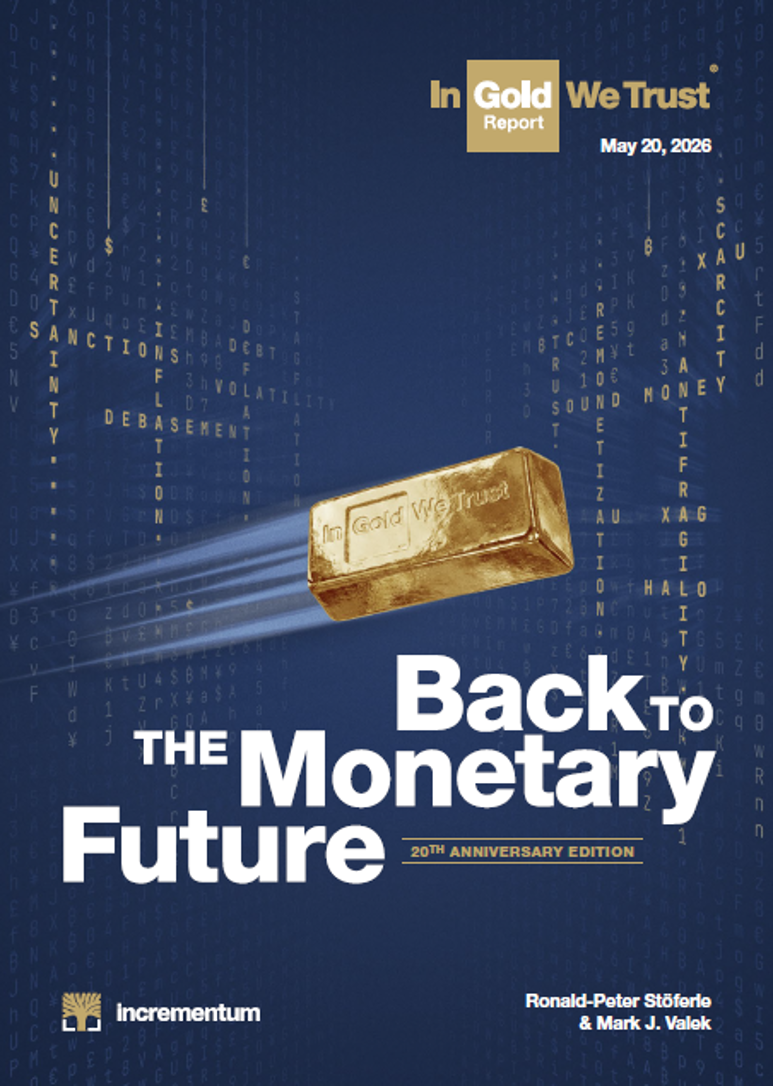
Fresh off a mountain bike crash, Ronnie Stöferle rejoins Ed Coyne for Part 2 of In Gold We Trust 2026. With a summer of growing Treasury intervention and an $8 trillion debt rollover looming, they discuss how gold's correction looks like a base camp rather than a peak. Other topics include silver's cleaner setup, the long-awaited rerating of gold miners, and why copper may be the cleanest AI play. Ronnie also previews next year's report and leaves one parting lesson for investors and cyclists alike: risk management matters, so wear a helmet.
Podcast Transcript
Ed Coyne: Hello, and welcome back to Part 2 of In Gold We Trust: Back to the Monetary Future with Ronnie Stöferle, Managing Partner at Incrementum AG. Ronnie, thanks for continuing to join me in the conversation on this year's In Gold We Trust. How are you holding up?
Ronnie Stöferle: I'm good. I'm much better now.
Ed Coyne: For those that don't know this, Ronnie, in the 30 days since we last spoke, has had some interesting things happen both to him and to the market. Why don't we start with how you're holding up, how you're doing, what happened? Then, let's go over all the changes we've seen in the market over the last couple of weeks as well.
Ronnie Stöferle: On a personal note, I had a pretty severe mountain bike accident, so I broke my collarbone and a couple of ribs. My wife and the kids weren't too happy about this development. It was tough, and the good thing is, it's impressive how quickly the body heals, and I'm much better now. I’ve already gone for a run again, and I can swim. Four weeks ago, I thought that was impossible, because it really hurt. One important piece of advice for our listeners: When you go mountain biking, wear a helmet. If I hadn't worn a helmet, I could be dead now. Yes, thank God.
Ed Coyne: I hate to be selfish about this, but that'd be a tragedy, not just for your family, your wife, and your children, but come on, In Gold We Trust. We've got 20 years of this thing. We need this thing to keep going. I love talking to you.
Ronnie Stöferle: Thanks.
Ed Coyne: There have been bike accidents, so to speak, in the market as well over the last couple of weeks. A lot of stuff has changed very quickly. I like to call it QE 3.0 and trade war infinity. Let's start with that. What in the world is going on out there, and what volatility are we seeing in the precious metals market? What's your take on that, as U.S. Treasuries seem to be becoming less popular, or at least shifting from maybe one country to another as far as who's buying them? What is your take on that right now? What's really happening?
Ronnie Stöferle: In our first conversation, I told you about this little Post-it note that I've got sitting on my table, which says, "Scare your investors out of bonds." This is a piece of advice that one of my very early mentors, a super successful businessman and investor, gave me: "That should be your mission as an asset manager." It still sits on my desk. I think he was way too early, but I think now is really the time.
We've seen enormous volatility in bond markets, and we used to say, "Don't fight the Fed." It seems to evolve into, "Don't fight the Treasury." I think the interventions we saw from Scott Bessent, with his notes saying, "Buy Japanese yen, sell euros," are not a coincidence. They started intervening in FX markets with only a tiny amount.
It worked a little bit. It put in a ceiling for the U.S. dollar versus the yen. Then, they continued with this special operation, moving from $2 to $4 billion on the long end of the curve. We can talk about the scale of this intervention, but I think it's clear that this government is becoming much more interventionist in capital markets.
It seems that 5% for the 10-year should really be the ceiling. I think we had it in the '60s and '70s. Once we went above 5%, we quickly went to 15%. I think we all know that it's simply unaffordable. That was probably the biggest news of this summer. I think we should expect much more of those interventions. I think that the market doesn't really believe that those amounts are enough. Therefore, I think the market will try to test Scott Bessent.
Ed Coyne: This is a number I still can't quite get my mind around. The cost of servicing U.S. debt today has now surpassed the annual cost of Medicare. I don't know how that story ends, but that can't be good. Over 50% of our budget is now dedicated to paying interest on debt. Do you see an environment where U.S. Treasury rates may continue to rise? Traditionally, that means the dollar gets stronger, but if it's going higher to entice more investors, do people start stepping away from the U.S. dollar? Do you see an environment where that could happen, given the various things happening out there in the marketplace?
Ronnie Stöferle: Yes, that would be the emerging marketization of the U.S. I think Louis-Vincent Gave wrote about that, basically saying that, "Emerging markets now act like developed markets, and developed markets are moving in the direction of emerging markets." The playbook has changed. For the U.S., I just looked it up; entitlements plus interest plus veterans' benefits, that's 105% of federal receipts, and growing 7.5% versus receipts growing by 4%. The math is the math. It's not just us in the gold community talking about that now.
There was a very interesting article by Ambrose Evans-Pritchard in The Telegraph, basically saying all the things we've been discussing for ages. It really has become mainstream. I think one of the biggest concerns nowadays is that we're seeing an $8 trillion rollover in the next 12 months. Somebody has to buy that. China no longer buys, and the Japanese want to repatriate capital, so this is a very interesting development.
I think we've seen most of the weakness in the Japanese yen. I would be somewhat bullish on the Japanese yen. Also, the Chinese renminbi has been doing tremendously well versus the U.S. dollar recently. Somebody has to buy it, and hedge funds have become the marginal buyer of U.S. debt. I think this is one of the reasons why Scott Bessent is getting increasingly nervous.
To answer your question, I think the U.S. obviously wants a weaker U.S. dollar, but on the other hand, Donald Trump has been quite vocal, saying the U.S. should have the lowest interest rates. He was wondering why Switzerland has low interest rates, and the U.S. does not. Something's got to give, and I think that gold, as always, perfectly smells and feels what's going on. It's already discounting what's going to happen.
Ed Coyne: You and others have always famously said, "Gold doesn't change; it's the market around it." You certainly are seeing that right now with what's going on. Not that long ago, I had a question for you that we didn't get to about why gold is selling off so much. Then, of course, that has changed drastically, and certainly, the miners have, and we'll get to that in a little bit.
Let's talk about the volatility. I think you already touched on it. Maybe the market isn't quite believing it yet. There seems to be a bit of a melt-up in the market that people don't believe is real. In your mind, what do you think is driving the volatility behind these big run-ups at the beginning of the year, then the big drawdown, and now another run-up again? What are some of the drivers behind that?
Ronnie Stöferle: Let's not forget that gold was up 64% in U.S. dollar terms last year. For a large asset class like gold, that's a major move. That was the biggest move since 1979. Then, we had this blow-off top in January 2026. In hindsight, it was obvious because the sentiment was extremely positive. Then, we had the change in margin requirements at CME.
We've had extreme futures positioning, CTAs, and so on. It was obvious that there would be a correction at some point. Then, I think the major disappointment for many market participants was that, with the start of the war in Iran, gold began selling off. Everybody thought, "Okay, well, this is the point in time when gold has to take off and go to $10,000 quickly."
I think it's important to emphasize that, in the short term, gold doesn't do too well in times of geopolitical turbulence, wars, terrorist attacks, and so on. Gold isn't a reliable short-term hedge against those developments. Over the medium- to long-term, wars mean higher inflation, more debt and lower real rates, but in the short term, gold isn't a good hedge. We've seen a big shift in expectations for interest rates this spring. We made a complete U-turn from one to two rate cuts to one or two rate hikes this year. Then some marginal buyers in the Gulf region could no longer recycle their earnings into gold.
Dubai, which accounted for 25% of global gold trade at one point, was no longer as popular, especially among expats. You can tell from ETF demand that Western financial buyers have resumed selling gold. We had this normal correction within a bull market over the last couple of months.
To be honest, Ed, I wouldn't have expected such a quick reversal as we've seen in August. That was a big comeback. I think it's telling that the $4,000 held. We're seeing a double bottom. We saw that China was buying hand over fist over the last couple of weeks. They bought 40 tons of gold in June alone. I think those more counter-cyclical actors, especially in Asia, were very happy about falling prices, and they loaded up the trucks. It seems that this bull market will continue. I wouldn't rule out new all-time highs in 2026.
Ed Coyne: Yes. It seems like silver's part of that party as well. Even though I've been arguing for a while now, I'm not sure it's gaining any weight, but that silver's really stepped out of gold's shadow. Maybe it's still tethered to it from a pricing or directional-move standpoint. What's your view on that? I know we spend a lot of our time talking about gold from a monetary metal standpoint and so forth, and how that reacts, but what's your view on silver as it's being consumed more as a critical material, yet it still moves a bit directionally with gold? How are you seeing silver right now?
Ronnie Stöferle: A friend of mine said, "Silver is gold with a day job." It's a monetary metal by night, and an industrial workhorse by day.
Ed Coyne: I think young kids call that a side hustle. I think silver has a side hustle.
Ronnie Stöferle: Yes, silver was up 146% last year. A tremendous year, and I think that silver delivered last year. Now, the gold-silver ratio is trading around 68 or 70. I think silver is still somewhat cheap relative to gold, but it's not like the gold-silver ratio at 100 early last year. I think the positioning is cleaner than gold's positioning. We're seeing open interest at 2008 lows. Net longs are at early 2024 levels, when silver was trading in the low $20s.
I think the macro tourists left. I like the setup at the moment. If my forecast is correct, that gold could make new all-time highs in 2026, then silver should do what it usually does. It should outperform gold. We all know the data from the industrial side: persistent deficits and little new supply coming online.
Have a look at the development of some high-quality silver miners. There are not too many quality names in the silver space, especially liquid ones. At these levels, I think silver has a great setup for the medium- to long-term.
Ed Coyne: Let's stay on that for a moment and talk about the miners, because they’ve had an incredible move in the last 30 days, ranging from 30% on the low end to 50% on the high end. The world's woken up. Is this yet another head fake for miners, or do you think Wall Street's finally recognizing the value in miners' margin expansion? What's your take on that?
Ronnie Stöferle: I hope it's not a head fake. Recently, gold went above the 200-day moving average, so we're in an uptrend again. From my perspective, what is interesting is that Newmont reached new all-time highs. Newmont was one of the best-performing stocks in the S&P 500 last year. I think the fact that we've now made new all-time highs is a sign that the big money is really getting interested. What do they usually buy? They don't buy small-caps or mid-caps. They go for the most liquid ones.
Ed Coyne: Sure.
Ronnie Stöferle: There are not too many liquid names where large investment funds managing several billion dollars could easily move in and out. I think the fact that Newmont is making new all-time highs on decent volume is a sign that generalists are finally coming in. If we look at the fundamentals, the balance sheets are fixed. The sector is now net cash. We're seeing record free cash flows, but the sector is basically trading at the same levels as in 2015.
Have a look at how much shareholder value those companies are creating now. It's not just the large caps; we also really like the royalty and streaming space. They're buying back shares and increasing their dividends. They don't engage in any ridiculous M&A like they usually do at every cycle. At some point, they probably will, but for the time being, we're seeing the sector now really at its healthiest since I've been covering it, and that's almost two decades.
I think we're finally seeing it, and I will be heading off to the two big conferences at Beaver Creek and then Colorado Springs in mid-September, and every year the narrative is, "The generalists are now coming." Last year, Denver Gold had more of the large-cap producers, while Beaver Creek had more of the small and mid-caps.
At Denver Gold, everybody said, "Now, the generalists are coming." I said, "Well, I don't see too many new faces. I'm seeing the same old faces that I've been seeing for many years." My friend Jordan said, "Fartcoin had a market cap of $2.5 billion." Why can't some quality gold and silver names really attract some capital in this market? Yes, we're allocating capital in the space, and it's not just gold and silver.
If you have a look at the copper chart, PGMs and uranium, I think that's a pretty good setup. I read recently that BHP Billiton now has the highest market cap in the Australian stock market. It used to be the financials for ages, and now it's a company from the resource space. I think that's a sign of much greater acceptance among the large institutional players now.
Ed Coyne: It's interesting you rattled off gold, silver, copper and uranium. What I find interesting about them is that each has its own story about what drives it, which I think is fascinating as well. It's not "a rising tide lifts all boats." Each metal is moving for a different reason, and I think that's fascinating. Can you talk about copper and uranium at all? Do you have any view on what's going on there since you brought that up?
Ronnie Stöferle: Everybody's talking about AI. If you're looking at valuations or at how much capital they are soaking up, we know the story. I think the better play on the whole AI story is in energy markets, and especially in copper. For one gigawatt of compute, you need roughly 60,000 tons of copper. If we're looking at all the data centers being built until 2030, that's 7% of global demand. That's basically the combined output of Escondida, Grasberg and Las Bambas. That's significant.
I think one of the main reasons that works for most commodities or metals is this CapEx cycle: throughout the whole bear market in commodities, we haven't seen any major investments. On top of that, one of the biggest trends in asset management was ESG and sustainability. I think in the U.S., it has been a little bit different. In Europe, if you went to an investment conference, you sometimes thought, "Okay, this is a Green Party convention or a Greenpeace meeting," because every asset manager was super sustainable and green.
Commodities and resources didn't really fit into this narrative. Everybody kicked it out of their portfolios, and now this is changing. That's also something we should do in our roles: educate investors outside our bubble by explaining the positive effects of mining, what it does for societies, the amount of infrastructure being built, and the high-quality, high-paying jobs being created.
I think the perception of mining is slowly changing outside of our little niche, and that's a positive thing. Coming back to copper, I think that's one of the cleanest AI plays. Regarding uranium, market participants' perception has shifted, and they now realize that we need clean, reliable energy for all the things happening in the world. I think that in the energy space, uranium is one of the most obvious medium- to long-term cases.
Ed Coyne: It's interesting you say that, because, even with these huge run-ups, it still feels like the foundation's just been built, and we haven't even started putting the house together yet. It's just incredible to me that it's moved as much as it has without major adoption by big institutions. We're just starting to see that right now. I've seen a lot of different numbers on this, but the one constant is that it's all below 1%.
Gold and silver, in general, are not big parts of a big institutional portfolio right now. That is starting to shift a little bit. Let's say it goes to 5%, what would that look like in your mind, just the general prices of things like gold, silver, copper, uranium, that kind of thing? As more institutions move into this space, how real and powerful is that driving force to elevate those prices even further?
Ronnie Stöferle: If we move to 5%, that should be good for prices. What we've been saying for a couple of years now is that the 60/40 portfolio is ending, and I think we talked about that previously and asked, "Where will the big money come from?" It's going to be from $150 trillion, which is allocated in fixed income. If there's just a small shift in the direction of hard assets, gold, silver, commodities, energy, perhaps Bitcoin, that will move the needle, because those asset classes are fairly small.
Inflation is a very big challenge for Kevin Warsh. He's Donald Trump's guy, and Donald Trump wants and needs lower interest rates. On the other hand, we're seeing that inflation has been sticky for how many months? I think inflation has been above the 2% target for 65 months. I think market participants have already given up on the 2% inflation target and realize that nobody really cares anymore.
That has consequences for capital allocation, and then we're moving toward this emerging marketification we talked about previously. Just one more thing, Ed. I’ve given keynotes in 35 or 40 countries around the world, primarily on gold, asset allocation and mining. By far, the best questions were asked when I did a keynote in Turkey, where these sophisticated institutional investors knew everything about gold. Why did they know everything about gold? Because they were used to a very weak currency, high inflation rates, and an unstable monetary system, it was obvious to them that they should have a view on gold and maintain a core allocation to it. I think we're slowly moving in that direction.
Ed Coyne: We’ve got some room to run based on supply-demand dynamics, investors coming in and how people are thinking about it. Gold is still widely viewed as something to trade rather than own permanently. You don't own it. You just trade it, try to catch it when it's rising, and try to dump it when it's selling off. I think the world is slowly waking up to it as an evergreen, permanent asset that helps diversify your portfolio.
I don't want to fast-forward to 2027, because I know you're still celebrating the completion of 2026, but what's percolating? What are you thinking about for 2027, as it relates to In Gold We Trust, 21st edition? What's already on your mind? What are you following? What are you excited about?
Ronnie Stöferle: We're already working on it. There's going to be a deep dive into China's gold trading infrastructure, with Hong Kong increasingly becoming a gold hub. This is going to be a very important topic. We'll have a big chapter on deep-sea mining and also asteroid mining. I think those are two interesting topics. We'll write about the valuation of the mining space and where we see the most value.
That sets us apart from other guys on YouTube making outlandish forecasts. We're asset managers, and we're still boutique. We're the shepherds of our clients' capital. If you're allocating capital, that's different from analyzing and making bold forecasts.
Ed Coyne: Right.
Ronnie Stöferle: Because we report a daily NAV, if we don't do our job well, we'll get feedback from our investors. To sum it up, gold is in a bull market, not in a bubble. I think that in Dow Theory terms, we're still in this public participation phase, which is the second part of the big trend. We're not in the distribution phase yet. I think I brought up this analogy the last time. When I'm not injured, I really like hiking and climbing mountains.
If you're climbing a really big mountain, you cannot run up that mountain. You have to take a break and get used to the altitude. I think this is what we've seen over the last couple of months, and at around $4,000, it seems the market put in a new base camp, if you will. Now, it seems that the next part of this big trip is starting, and our long-term target is $8,900 by 2030. It sounds familiar because Mount Everest is 8,849 meters high. That's just a coincidence, but I think we're going to climb Everest.
Ed Coyne: Ronnie, they say there's no coincidence. You're too smart not to have those two things tied together. Listen, this is always great. Always great to get you. Please take care of yourself. We need you around. I'm glad you're recovering nicely. It'll be interesting to see where we land over the next couple of months between now and the end of the year. Anything before we say goodbye? Anything else you wanted to deliver?
Ronnie Stöferle: Just one of my takeaways from this summer: if you ride a bike, wear a helmet. Risk management is important, not only in asset management but also in sports.
Ed Coyne: I see our producer, Stewart, smiling, because I believe that's probably going to be the artwork now for this podcast, just based on that comment. We'll see. Ronnie, thanks again. It was great to talk to you. Have a good rest of the summer and into the fall, and thank you all for listening. Once again, I'm Ed Coyne, and you're listening to Sprott Radio.


Ronald-Peter Stöferle
Managing Partner of Incrementum AG
Important Disclosures
This podcast is provided for information purposes only from sources believed to be reliable. However, Sprott does not warrant its completeness or accuracy. Any opinions and estimates constitute our judgment as of the date of this material and are subject to change without notice. Past performance is not indicative of future results. This communication is not intended as an offer or solicitation for the purchase or sale of any financial instrument.
Relative to other sectors, precious metals and natural resources investments have higher headline risk and are more sensitive to changes in economic data, political or regulatory events, and underlying commodity price fluctuations. Risks related to extraction, storage and liquidity should also be considered.
Gold and precious metals are referred to with terms of art like store of value, safe haven and safe asset. These terms should not be construed to guarantee any form of investment safety. While “safe” assets like gold, Treasuries, money market funds and cash generally do not carry a high risk of loss relative to other asset classes, any asset may lose value, which may involve the complete loss of invested principal. Furthermore, no asset class provides investment and/or wealth “protection”.
Any opinions and recommendations herein do not take into account individual client circumstances, objectives, or needs and are not intended as recommendations of particular securities, financial instruments, or strategies. You must make your own independent decisions regarding any securities, financial instruments or strategies mentioned or related to the information herein.
While Sprott believes the use of any forward-looking language (e.g., expect, anticipate, continue, estimate, may, will, project, should, believe, plans, intends, and similar expressions) to be reasonable in the context above, the language should not be construed to guarantee future results, performance, or investment outcomes.
This communication may not be redistributed or retransmitted, in whole or in part, or in any form or manner, without the express written consent of Sprott. Any unauthorized use or disclosure is prohibited. Receipt and review of this information constitute your agreement not to redistribute or retransmit the contents and information contained in this communication without first obtaining express permission from an authorized officer of Sprott.
©Copyright 2026 Sprott All rights reserved